


Company Registration In USA From India - Step by Step Guide
Starting a business in the United States is no longer limited to people living there. Today, thousands of Indian founders, freelancers, SaaS builders, Amazon sellers, and agencies are choosing to register company in USA from India – without ever boarding a flight.
Whether you’re planning to sell to US customers, receive international payments smoothly, or build a global brand, US company formation for Indians offers clear advantages. The best part? The entire process can be completed remotely if you follow the right steps.
In this complete guide, I’ll explain how to open a company in USA from India, covering structure selection, documents, costs, timelines, and common mistakes – based on real founder scenarios, not theory.
Why Do Indian Founders Register a Company in USA?
Global Credibility:
A US company instantly increases trust with international clients, especially in B2B services, SaaS, and consulting.
Easy Access to Global Payments:
US companies can use Stripe, Wise, Mercury, Brex, and other global payment platforms without complications and smoothly
Founder-Friendly Business Laws:
States like Delaware and Wyoming are known for predictable laws and low compliance burden.
Investor & Startup Ecosystem
Many venture capital firms and startup accelerators are more comfortable investing in US-registered companies, with Delaware C-Corporations being the most widely accepted structure.
Common Real-Life Indian Scenarios
• A Bangalore-based SaaS founder wants to sell to US customers using Stripe
• A Mumbai agency owner struggles with international wire transfers
• An Amazon India seller expands to Amazon.com
• A startup applying to Y Combinator needs a Delaware C-Corp
• A freelancer loses deals because clients prefer US vendors
In all these cases, company registration in USA from India becomes a strategic decision.
Who Can Register a Company in USA from India?
One common myth is that you need US citizenship or residency. That’s not true. And you can register company in USA from India if you are:
• An Indian citizen
• A non-resident of the US
• A solo founder or co-founder
• A freelancer, agency owner, or startup founder
• Running an online or export-oriented business
👉 No SSN required. No US visa needed. No travel mandatory.
Types of Companies Indians Can Register in the USA
Before starting the registration process, you must know the right structure which suits your business. so choosing between an LLC and a C-Corporation is not about which is “better.”
It’s about how you plan to use your US company, how you’ll earn money, and whether you plan to raise funding in the future.
Let’s break this down in a way Indian founders actually understand.
LLC (Limited Liability Company):
Best for:
• Freelancers & independent professionals
(software developers, designers, consultants working with US or global clients)
• Consultants & service providers
(IT consulting, marketing, business advisory, outsourcing services)
• Digital & marketing agencies
offering services to US or international clients
• Amazon FBA & eCommerce sellers
selling on Amazon US, Shopify, Etsy, or similar platforms
• Bootstrapped founders
who want to start quickly and keep costs and compliance low
Why LLC works well here:
Most Indian founders in services or eCommerce do not need investors on day one.
They want:
• Fast setup
• Simple compliance
• Flexible tax treatment
An LLC fits this perfectly.
Real-life example:
An Indian digital marketing agency working with US clients can form a Wyoming or Delaware LLC, receive payments in USD, open a US bank account, and operate legally – without complex corporate formalities.
C-Corporation
Best for:
• Startups planning to raise VC or angel funding
• SaaS and tech product companies
• Companies planning to issue shares or ESOPs
• Founders building for long-term scale and exit
If your goal is to build a fundable startup, a C-Corp is usually the right structure.
Why investors prefer C-Corporations:
Most US investors especially VCs – only invest in C-Corporations, typically incorporated in Delaware.
Real-life example:
An Indian SaaS founder building a B2B product for the US market will almost always be advised by accelerators and investors to form a Delaware C-Corporation, even before pitching.
What Most Indian Founders Actually Choose
Based on real-world patterns:
- LLC →
For services, consulting, freelancing, and eCommerce businesses
where cash flow and simplicity matter more than investors C-Corporation →
For startups, SaaS products, and VC-backed companies
where fundraising, equity, and long-term growth are the priority
There is no one-size-fits-all answer – but choosing the right structure early saves Indian founders from expensive restructuring later.
Step-by-Step Process to Register a Company in USA from India
Let’s break down how to open a company in USA from India, step by step.
Step 1: Choose the State of Registration
This decision affects cost, tax, and future scalability.
Popular states for Indians:
- Delaware – Startups & investors
- Wyoming – Low cost & privacy
- Texas – Operating presence
Each state has different fees and compliance rules.
Step 2: Select Company Name
Your company name must:
- Be unique in that state
- Include “LLC” or “Inc”
- Not infringe trademarks
Step 3: Appoint a Registered Agent
US law requires a registered agent with a physical US address to receive legal notices. He will receive all documents on behalf of you.
Step 4: File Formation Documents
- LLC → Articles of Organization
- Corporation → Articles of Incorporation
Filed with the state government.
Step 5: Get EIN from IRS
An EIN (Employer Identification Number) is required for:
- Bank account
- Tax filing
- Payment gateways
Issued by the Internal Revenue Service (IRS).
Step 6: Open US Business Bank Account
Many banks allow remote account opening for non-residents, depending on structure and documents. Learn how to open a bank account in USA from India safely and legally.
Step 7: Ongoing Compliance
Federal Tax Filing (Annual Filing), taxes, and renewals must be done on time to keep the company active.
Documents Required for Company Registration in USA from India
This is where many people overthink. But the process is simpler than expected.
Documents Required for LLC (Indian Owner)
- Indian Passport (mandatory)
- Indian residential address
- Email ID & phone number
- Company name & activity description
Documents Required for C-Corp (Indian Founder)
- Passport of all shareholders
- Indian address proof
- Shareholding details
- Director information
Important:
• No Aadhaar required
• No PAN mandatory for formation
• No notarization in most cases
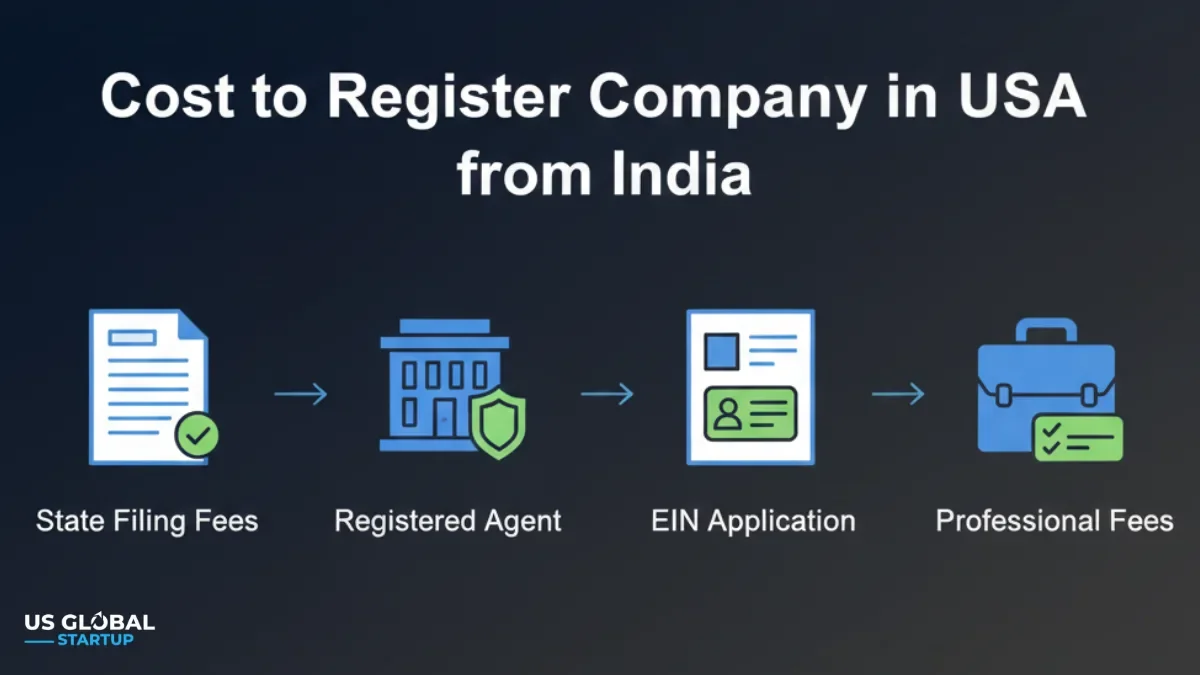
Cost To Register Company In USA From India
Costs vary by state and structure.
Typical Cost Components:
- State filing fee
- Registered agent fee
- EIN application
- Professional service fee
💡 Wyoming is usually the most cost-effective, while Delaware is premium but investor-friendly.
Time Required for US Company Incorporation
| Step | Time |
|---|---|
| Company formation | 1–3 business days |
| EIN from IRS | 5–15 business days |
| Bank account | 7–14 days |
Total: 2–4 weeks on average
Tax & Compliance Overview for Indian-Owned US Companies
This is where many founders get confused—especially during USA Company Registration From India, when tax and compliance rules differ sharply from Indian systems.
Federal Taxes
- LLC → Pass-through or elected taxation
- C-Corp → Corporate tax filing
State Taxes
Depends on:
- State of incorporation
- Business activity location
Reporting Obligations
- Annual state reports
- Federal tax returns
- BOI reporting (as applicable)
👉 Official USCIS site (general reference): https://www.uscis.gov
👉 State info example: https://corp.delaware.gov
Tax Structure for Indians Registering Company In USA
Most Indian either overpay tax due to fear or under-report due to wrong advice. Let’s break this down with actual numbers and scenarios..
Taxation for LLC Owned by Indian Residents
By default, a single-member US LLC owned by an Indian resident is treated as a pass-through entity for US tax purposes.
How Tax Works at a Basic Level
- The LLC itself usually does not pay corporate tax
- Profit “passes through” to the owner (you, in India)
- Tax depends on where the income is earned
Effectively Connected Income (ECI) – The Key Concept
US tax applies only if income is “effectively connected” to the US, such as:
- Office or employees in the US
- US-based operations
- Warehousing or fulfillment in the US
Most Indian founders operate US Company from India after registration, so income is often NOT ECI.
Example 1: Indian Consultant with US LLC (No US Presence)
- Owner: Indian resident
- Services delivered from India
- Clients mostly global
- No US office, no US employees
US Federal Tax:
- Usually $0 on business profit
- Only informational returns required
Indian Tax:
- Entire profit taxed in India as foreign income
- Taxed as per Indian slab rates
Example 2: Numbers Breakdown (LLC)
Assume:
- Annual profit: $50,000
- USD to INR (approx): ₹83
- Total INR income: ₹41.5 lakhs
India Tax Treatment:
- Added to total income
- Taxed under individual slab
- If in 30% slab → ~₹12–13 lakhs tax
US Tax: $0
India Tax: Yes (full amount)
Important Filing Requirement (Even If Tax = Zero)
Even if no tax is payable in the US:
- Form 5472
- Pro-forma Form 1120
- State compliance (if applicable)
Non-filing penalties can start from $25000+, so compliance is critical.
Taxation for C-Corporation Owned by Indians
A C-Corporation is a separate tax-paying entity.
US Corporate Tax Rate
- Flat 21% Federal Corporate Tax
- State tax may apply depending on operations
Example 1: C-Corp Profit Calculation
Assume:
- Annual profit: $100,000
US Federal Corporate Tax:
- 21% of $100,000 = $21,000
Remaining after tax:
- $79,000 retained in company
What Happens When You Take Money from C-Corp to India?
This is where double taxation concern arises, but it’s manageable.
Option 1: Salary to Indian Founder
- Salary paid to Indian resident
- Taxed in India as salary income
- Deductible expense for US company
- Reduces US corporate tax
Common strategy for founder-managed startups.
Option 2: Dividends to Indian Shareholder
- Dividends paid after corporate tax
- US withholding tax applies
Dividend Tax Numbers
- US withholding tax: 25% (default)
- Reduced to 15% under India–US DTAA
👉 Example:
- Dividend paid: $50,000
- US tax withheld: $7,500 (15%)
- Net received in India: $42,500
India Tax on Dividends
- Dividends are taxable in India
- Taxed as per individual slab
- Foreign Tax Credit (FTC) available for US tax paid
This avoids double taxation if correctly filed.
State-Wise Tax For Indian Registered Company In United States
Delaware
• No state income tax if no physical operations in Delaware
Franchise tax:
• LLC: ~$300/year
• C-Corp: can range from $175 to thousands (depends on structure)
Delaware is tax-neutral for non-operating companies.
Wyoming
• 0% state income tax
• Annual report fee is minimum ~$60
Very popular among Indian founders for cost efficiency
Texas
• No personal income tax
Franchise tax:
• Applies if revenue exceeds threshold (~$2.47 million)
• Below threshold → No tax filing amount, only report
Suitable if you plan US operations later
Bringing Profit from US Company to India
This is 100% legal when done correctly.
For LLC
Profit already belongs to owner so he can remit funds to India as:
• Owner’s draw
• Business income
India tax applies regardless of remittance timing.
For C-Corp
Money can be brought to India as:
- Salary
- Dividends
- Reimbursement (limited cases)
Each has different tax impact so planning matters.
India Reporting You Must Not Ignore
Indian residents must report foreign assets and income in:
- Schedule FA (Foreign Assets)
- Schedule FSI (Foreign Source Income)
Failure to disclose can attract:
- Heavy penalties
- Scrutiny under Black Money Act
This is compliance, not something to fear—just do it right.
Why Professional Tax Guidance Is Strongly Recommended
Because:
- US rules ≠ Indian rules
- DTAA benefits must be claimed correctly
- Filing formats differ for LLC vs C-Corp
Even founders with zero US tax need expert filing.
Key Takeaway for Indian Founders
- US company ≠ automatic US tax
- India tax applies to Indian residents
- Compliance is mandatory even if income is zero
- With proper structuring, tax remains optimized and legal
This clarity alone saves Indian founders lakhs every year.
Common Mistakes To Avoid If Registering Company In USA From India
From real cases, these are the most common issues:
- Choosing wrong state without understanding future needs
- Ignoring tax filing deadlines
- Mixing personal & business payments
- Using random agents without compliance support
- Not planning for Indian tax implications
This is why professional guidance matters
Common FAQs on How to Register Company in USA From India
Yes. An Indian citizen can legally form and own a company in the United States without being a US resident. No US visa, SSN, or physical presence is required. The entire setup process can be completed remotely using an Indian passport and basic business details.
No. Indians do not need a US visa, SSN, or ITIN to register a company in the USA. A valid Indian passport is usually sufficient for company formation.
Yes. An Indian citizen can own 100% of a US company. There is no requirement to have a US partner, director, or shareholder.
There is no single “best” state for everyone, but Delaware and Wyoming are the most preferred options for Indian founders. Delaware is ideal for startups planning to raise funds or work with US clients, while Wyoming suits small and service-based businesses due to lower annual costs and simpler compliance.
An EIN (Employer Identification Number) is a US tax identification number issued by the IRS. Indian founders need an EIN to open a US business bank account, file tax returns, and legally operate a company in the United States.
it depends on factors such as the state of formation, company type (LLC or C-Corporation), and required services like EIN, registered agent, and compliance support. For Indian founders, the overall setup expense typically falls between USD 300 to USD 1000, excluding ongoing annual filing and tax costs.
Registered agent services typically cost USD 50 to USD 300 per year, depending on the state and service level. This is a recurring annual requirement for keeping the company active.
Yes. Many Indian founders open US business bank accounts online through approved fintech banks. Assistance is available to avoid unnecessary delays or rejections.
Yes. You can operate your US company fully from India. Hiring US employees or having a physical office is not required unless your business model demands it.
Yes. Once you register a company in USA from India, annual US tax filing is mandatory, even if there is no income. Non-filing can lead to penalties or company closure.
Yes, Indian residents must report global income in India.
However, tax treaties between India and the USA help avoid double taxation when structured correctly.
GST is not mandatory just because you own a US company. However, if services are provided from India or invoices are raised to Indian clients, GST rules may apply based on your business model.
