


IRS Data Book 2025 Report Shows $5.3 Trillion in Tax Collections and Rising Use of Digital Services
The IRS has released the IRS Data Book 2025 Report, which provides a detailed look at the agency’s operations during Fiscal Year 2025. The report highlights tax collections, tax refunds, audits, taxpayer assistance, online services, and the impact of new tax benefits introduced under the Working Families Tax Cuts Act – all key considerations for anyone managing their Federal Tax Filing this year.
What Is the IRS Data Book?
The IRS Data Book is an annual publication that summarizes the agency’s activities and performance during the fiscal year. It includes statistics on tax return processing, revenue collection, refunds, taxpayer services, enforcement activities, audits, and workforce operations.
Rather than announcing new tax rules, the report provides a statistical snapshot of how the IRS operated during the year and how taxpayers interacted with the agency.
Why Does the IRS Publish the Data Book Every Year?
The IRS publishes the Data Book to provide transparency about its operations and responsibilities. The report helps taxpayers, businesses, tax professionals, researchers, and policymakers understand the scale of the agency’s work and track trends in tax administration over time.
By releasing these figures annually, the IRS provides insight into how many returns were filed, how much tax revenue was collected, how many refunds were issued, and how taxpayer services are being used.
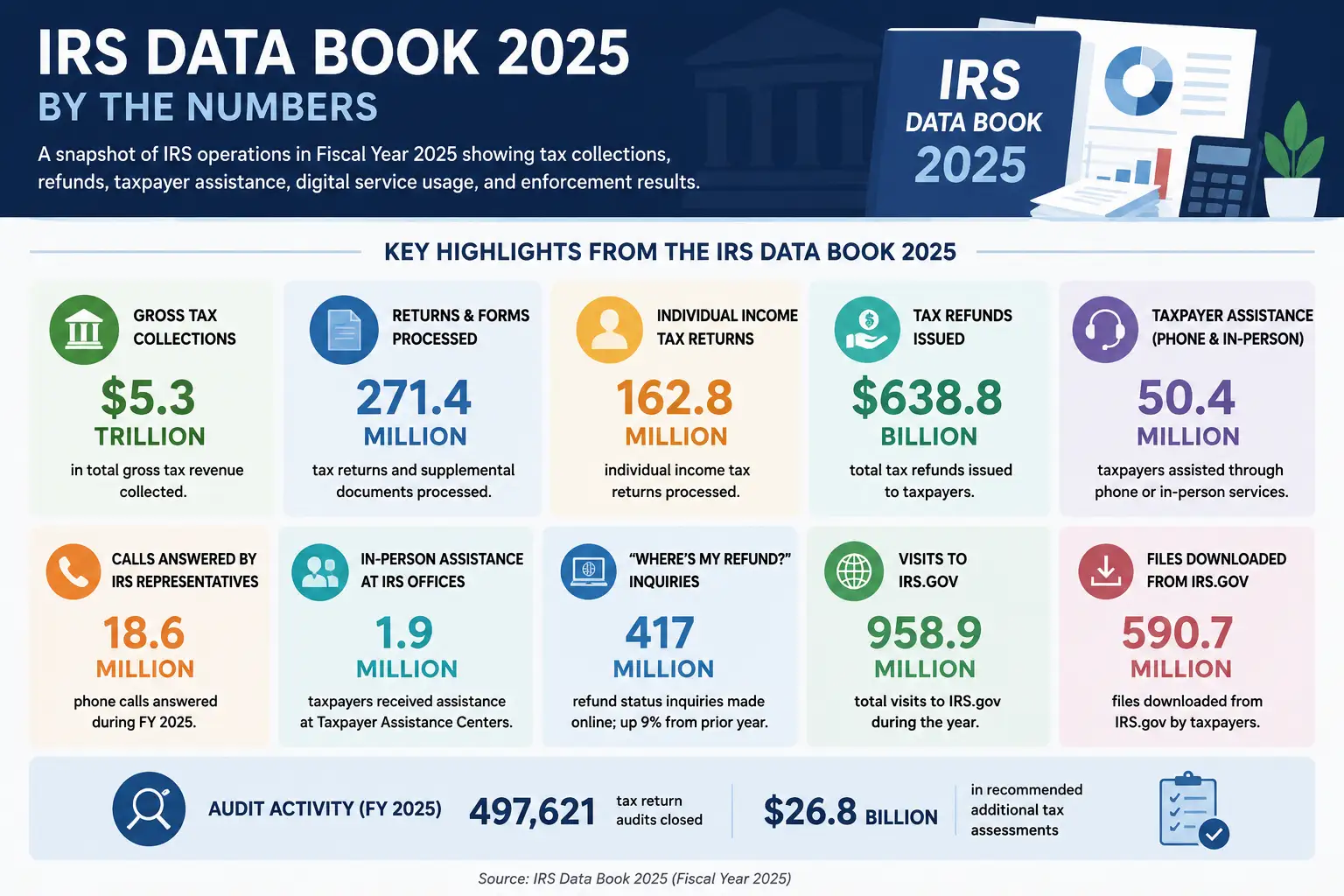
IRS Collected More Than $5.3 Trillion in Federal Taxes
The report shows that the IRS collected more than $5.3 trillion in gross tax revenue during Fiscal Year 2025. For comparison, the agency collected approximately $5.1 trillion during Fiscal Year 2024, indicating continued growth in federal tax collections.
This represents one of the largest annual tax collection totals reported by the agency. The increase was driven primarily by higher collections from individual income taxes and other tax categories.
These collections fund a wide range of federal government programs and services, making tax administration one of the most important functions performed by the IRS each year.
Nearly Half of Taxpayers Claimed New Tax Benefits
One of the most significant findings in the IRS Data Book 2025 relates to the new tax benefits introduced under the Working Families Tax Cuts Act (WFTC).
According to the report, approximately 45% of individual tax returns filed during the 2026 filing season claimed at least one of the newly available tax benefits. These included:
- Tip Income Deduction - Up to $25,000
- Overtime pay deduction of up to $12,500 for individuals and $25,000 for married couples filing jointly
- Car Loan Interest Deduction - Up to $10,000
- Additional senior deduction of up to $6,000 per eligible taxpayer
The IRS reported that taxpayers who claimed one or more of these benefits received an average tax refund exceeding $3,200 as of May 27.
This indicates that millions of taxpayers took advantage of the new deductions and tax relief provisions during the filing season.
More Than 271 Million Tax Returns and Forms Processed
The IRS Data Book 2025 reports that the agency processed 271.4 million tax returns and supplemental documents during the fiscal year.
Of these, nearly 162.8 million were individual income tax returns, while the remaining filings included business tax returns, payroll tax forms, information returns, and other federal tax documents.
The volume shows the enormous growth of the U.S. tax system and the administrative responsibilities handled by the IRS annually.
Taxpayer Assistance Remains a Core IRS Function
While online services continue to expand, millions of taxpayers still rely on direct support from the IRS.
During Fiscal Year 2025:
- IRS customer service representatives answered nearly 18.6 million phone calls.
- Almost 2 million taxpayers received in-person assistance at Taxpayer Assistance Centers.
- A total of 50.4 million taxpayers were assisted through phone or office visits.
These figures show that traditional taxpayer services remain an important part of IRS operations, especially for individuals seeking help with tax filings, payment issues, refunds, or compliance questions.
Online Tax Services Continue to Gain Popularity
The IRS Data Book 2025 also highlights growing demand for digital tax tools and self-service resources.
One of the most widely used online services remains the “Where’s My Refund?” tool, which allows taxpayers to track their refund status online.
During Fiscal Year 2025:
- Taxpayers made nearly 417 million refund status inquiries.
- Usage increased by 9% compared to the previous year.
- IRS.gov recorded 958.9 million visits.
- Taxpayers downloaded 590.7 million files from the IRS website.
The numbers suggest that taxpayers increasingly prefer online tools for checking refunds, accessing tax forms, managing accounts, and obtaining tax information.
IRS Expands Technology and Digital Transformation Efforts
A major theme throughout IRS annual report 2025 is the agency’s continued focus on moving taxpayer services and internal processes to digital platforms while reducing processing delays
The IRS stated that it is upgrading online accounts for both individuals and businesses while expanding the use of advanced technology and analytics. According to the report, these systems help identify potential tax fraud, improve compliance monitoring, and enhance taxpayer service.
The agency also highlighted its ongoing “zero paper” initiative, which aims to reduce paper-based processing and move more tax administration functions into digital environments.
Audit Activity Generated Billions in Recommended Additional Tax
The IRS annual report 2025 also includes updated audit statistics for Fiscal Year 2025.
During the year, the IRS closed 497,621 tax return audits, resulting in approximately $26.8 billion in recommended additional tax assessments.
These examinations – help to ensure that tax laws are applied consistently across individual and business taxpayers.
12 Key Trends From IRS Data Book 2025 (Highlight)
Here are some of the most important IRS statistics from 2025 report:
- $5.3 trillion in gross taxes collected
- 271.4 million tax returns and related forms processed
- 162.8 million individual income tax returns processed
- $638.8 billion in tax refunds issued
- 50.4 million taxpayers assisted by phone or in person
- 18.6 million calls answered by IRS representatives
- Nearly 2 million taxpayers assisted at IRS offices
- 417 million “Where’s My Refund?” inquiries
- 958.9 million visits to IRS.gov
- 590.7 million files downloaded from IRS.gov
- 497,621 audits completed
- $26.8 billion in recommended additional tax from audit activity
Need assistance with U.S. tax obligations? Contact US Global Startup for professional support.
Conclusion
The IRS Data Book 2025 provides a comprehensive look at tax administration during Fiscal Year 2025. From processing more than 271 million tax filings to issuing hundreds of billions of dollars in refunds and expanding digital taxpayer services, the report highlights the scale of IRS operations and the growing role of technology in managing the federal tax system.
Common FAQs on IRS Annual Report 2025
Does the IRS Data Book 2025 show how many Americans got a tax refund?
Yes! The Data Book tracks refund statistics including how many refunds were issued, total dollars refunded, and which credits - like the Child Tax Credit and Earned Income Tax Credit - were most commonly claimed. It gives a clear picture of how much money went back into Americans' pockets.
Did the IRS collect more or less tax money in 2025 compared to previous years?
The IRS collected over $5.3 trillion in fiscal year 2025, which is one of the highest collection figures in IRS history. This money funds everything from roads and schools to military and healthcare programs across the United States.
Does the IRS Data Book 2025 show which states paid the most taxes?
Yes! The IRS Data Book 2025 breaks down tax collection and filing data by state. States like California, New York, and Texas typically top the list due to their large populations and high-income earners. This data helps you understand how your state compares to the rest of the country when it comes to federal tax contributions.
How does the IRS Data Book 2025 help me understand my chances of getting audited?
The Data Book publishes audit rates by income level and return type. For example, it shows what percentage of people earning under $50,000 were audited versus those earning over $500,000. This is very useful for average Americans to realistically understand their audit risk and make sure their tax returns are accurate and well-documented.
Does the IRS Data Book 2025 include information about tax-exempt organizations like nonprofits?
Absolutely. The IRS annual report 2025 covers tax-exempt organizations including charities, churches, foundations, and nonprofits. It shows how many organizations were approved for tax-exempt status, how many had their status revoked, and how many were reviewed for compliance.
What does the IRS Data Book 2025 reveal about identity theft and tax fraud protection?
The IRS Data Book 2025 highlights how the agency is fighting tax-related identity theft - one of the biggest concerns for American taxpayers. It shows how many fraudulent returns were flagged and stopped, how many Identity Protection PINs were issued to protect taxpayers, and what new systems the IRS put in place to make sure your refund goes to you and not a fraudster.