

File Form 1040 Online – Professional US Individual Tax Preparation Services
Form 1040 Filing Service Starting From $250 View Pricing →
Everything Included When you NeedForm 1040 Filing Service
Filing Status & Residency Confirmation
Making sure you're correctly filing as a resident (not accidentally using the wrong form)
Complete Form 1040 Preparation
Every schedule your return requires - Schedule 1, 2, 3, C, or the new Schedule 1-A - prepared accurately
Standard vs. Itemized Deduction Review
We calculate both and use whichever actually lowers your tax bill
E-File Form 1040 Online Service
Electronic filing with IRS confirmation, not a paper form left to chance
Deadline & Extension Tracking
Your April 15 deadline tracked, with Form 4868 filed for you if an extension is needed
Refund & Payment Guidance
Clear guidance on direct deposit for refunds, or payment options if you owe
File Form 1040 Online
Having trouble submitting the form? Contact us on WhatsApp or email us at support@usglobalstartup.com, and we’ll be happy to assist you.
What Is Tax Form 1040?
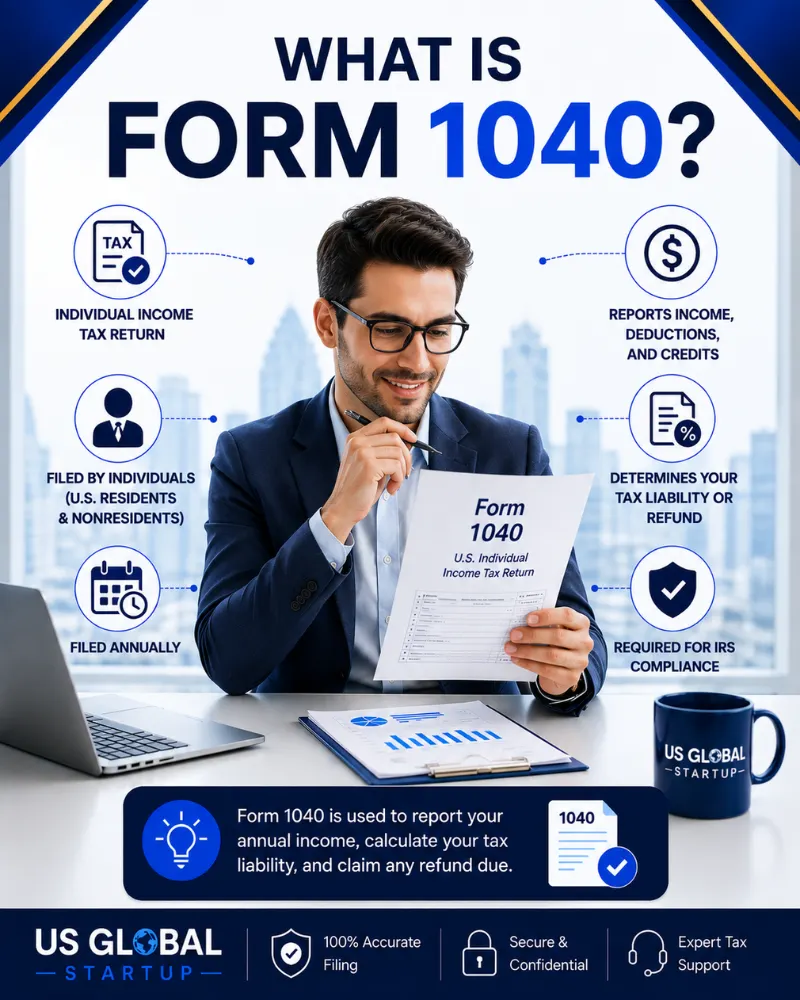
Form 1040 is the standard US individual income tax return used by US citizens and resident aliens to report worldwide income – including wages, self-employment income, investment income, and more – to the IRS each year. It is the primary return prepared as part of individual tax preparation services.
Unlike Form 1040-NR, which only reports US-source income for nonresident aliens, Form 1040 requires you to report all income earned worldwide, regardless of where it was paid or where the work was performed.
When is the best time to do taxes?
The best time to do your taxes is as soon as you have all your income documents, such as your W-2s and 1099s. For most people, this is between late January and February. Filing early through an online tax filing service for individuals can help you receive your refund sooner and gives you extra time to fix any issues before the April 15 deadline.
Are Tax Refunds Taxable Income?
Federal tax refunds are generally not taxable income, because they are simply a refund of taxes you overpaid. However, a state tax refund may be taxable on your federal return if you itemized deductions in the previous year and claimed your state taxes as a deduction.

Who Needs This Form 1040 Filing Service?
You need to File Form 1040 Online if you fall into any of these categories:
- US citizens, regardless of where in the world they currently live.
- Green card holders (resident aliens under the green card test).
- Visa holders who’ve passed the substantial presence test, such as H-1B, L-1, or O-1 holders who’ve been in the US long enough to be taxed as residents.
- Former non-resident business owners whose status has changed from nonresident alien to resident alien for tax purposes.
- Anyone with US-source and worldwide income who no longer qualifies to file Form 1040-NR.
If you’re not sure which category applies to you-especially if your visa or residency status changed during the year – it’s important to get it right the first time. Filing the wrong tax return can create bigger problems than filing the correct one late. This is where a professional income tax service can help, rather than relying on a generic best online tax file tool that may not properly assess your residency status.
Form 1040 Tax PreparerCost
Complete Income Review
We review your W-2s, 1099s, self-employment income, investments, and more before preparing your return.
Every Credit You Actually Qualify For
Child tax credit, education credits, retirement contributions - We check your eligibility for credits and deductions to help maximize your tax savings.
Self-Employed or Multiple Income Streams? Handled
Freelance income, gig work, rental income, and multiple income sources are handled accurately.
Personalized Tax Preparation
Whether you're single with one W-2 or a family have five income sources, your return gets the same level of care
Accurate and On-Time Filing
Accuracy now means no IRS letter showing up eight months later
50+
Form 1040 Filings
100%
E-Filed With IRS
Form 1040 Preparation Service Charge
- Form 1040 preparation & review
- W-2, 1099 & self-employment income reporting
- Standard vs. itemized deduction comparison
- Tax credits & deduction eligibility review
- Required schedules included (Schedule 1, C, D, etc.)
- IRS e-filing & acceptance confirmation
- Form 4868 extension filing (if required)
- Support for resident aliens & US citizens
What Is the Difference Between Form 1040 and W-2?
1040 vs W-2 is a common point of confusion. These are not two tax forms you choose between. A W-2 is a wage and tax statement your employer provides, while Form 1040 is the annual tax return you file using your W-2 and any other income documents.
| Comparison | Form 1040 | Form W-2 |
|---|---|---|
| What it is | Your annual income tax return | A wage and tax statement |
| Who prepares it | You (or your tax preparer), using your W-2 and other income documents | Your employer |
| Who files it | You file it with the IRS yourself | Your employer sends it to the IRS and to you |
| What it reports | Total income from all sources, deductions, credits, and final tax owed or refunded | Wages paid and taxes withheld for the year (Box 1: wages, Box 2: federal tax withheld) |
| When you receive/file it | Due April 15, with extensions available to October 15 | Employers must send W-2s by January 31 |
| How many you might have | One per year, combining all income sources | One per employer (multiple if you changed or held several jobs) |
Here’s how it works: The wages and federal income tax withheld shown on your W-2 are reported on your Form 1040 when you e-file Form 1040 online. If you have multiple W-2s from different employers, you combine all of them into a single Form 1040 – you do not file a separate return for each job.
If your tax situation includes more than just wages, our US Federal Tax Return Filing service can prepare your Form 1040 along with any other required federal tax filings.
Do S Corporation Owners Need to File Form 1040?
Yes. If you own an S Corporation, you generally still need to file Form 1040 as your personal income tax return. Income, deductions, and credits from the S Corporation are typically reported on Schedule K-1 (Form 1120-S) and included on your Form 1040. If you need assistance, our Form 1040 Filing Service can help you prepare and file your return accurately.
How to Choose Your Filing Status on Form 1040?
Your filing status affects your standard deduction, tax brackets, and eligibility for certain credits, so choosing the correct status is important. There are five filing status options, and your status is based on your situation as of December 31 of the tax year:
Single:
unmarried, divorced, or legally separated, with no dependents qualifying you for Head of Household
Married Filing Jointly (MFJ):
married couples combining income and deductions on one return; usually the lowest combined tax, but it depends on your situation.
Married Filing Separately (MFS)
married but filing individual returns; sometimes useful for specific situations (like income-driven student loan repayment or protecting one spouse from the other’s tax liability), but it often loses access to certain credits and has a lower standard deduction than MFJ
Head of Household (HOH)
unmarried and paying more than half the cost of maintaining a home for a qualifying dependent; comes with a higher standard deduction than Single status
Qualifying Surviving Spouse
available for up to two years after a spouse’s death if you have a dependent child, allowing you to use the same standard deduction and brackets as Married Filing Jointly
Documents Required to File Form 1040 Online
- W-2 forms from every employer you worked for during the year
- 1099 form - for freelance income (1099-NEC), interest/dividend (1099-INT/DIV), or retirement distributions (1099-R)
- Records of any self-employment income and expenses, if applicable
- Prior year's tax return, for reference and carryover items
- Records for itemized deductions, such as mortgage interest statements, property tax records, and charitable donation receipts, if you're not claiming the standard deduction.
- Social Security numbers for yourself, your spouse, and any dependents - if a spouse or dependent doesn't have an SSN and isn't eligible for one, they'll need an ITIN instead; our ITIN Registration service handles that application so it doesn't hold up your filing
- Bank account details for direct deposit of any refund
How to File Form 1040 Online: Step-by-Step Process
Our individual tax preparation services ensure your Form 1040 is prepared accurately, reviewed carefully, and e-filed with the IRS correctly without any error.
Step 1: Share Your Income Details
Send us your W-2s, 1099s, and other income documents for the year, including freelance income, interest or dividend statements, retirement distributions, and any other earnings. If you are missing a form, we help identify what is needed before moving forward.
Step 2: We Confirm Your Filing Status and Residency
Before preparing your return, we verify your filing status and residency to ensure you are using the correct tax form. This is especially important if your visa or residency status changed during the year.
Step 3: We Prepare Your Complete Return
We prepare your Form 1040 with all required schedules, such as Schedule 1 for additional income and Schedule C for self-employment income. We also compare standard and itemized deductions to determine which option may provide the best tax outcome.
Step 4: Review & Sign-Off
You review the completed return before submission to ensure everything is accurate and approved before it is filed with the IRS.
Step 5: File Form 1040 and Confirmation
After your approval, we e-file Form 1040 online through our secure system and provide confirmation once your return is accepted by the IRS. We also share your refund timeline or payment options if you have a tax balance due.
How Long Does It Take to File Form 1040?
Most Form 1040 returns are prepared and filed within 10 to 15 business days after we receive all the required documents. Our Form 1040 filing service timeline depends on the complexity of your return, income sources, and whether any additional information is needed during the preparation process.
What is the Deadline to File Form 1040 & Extension
For most taxpayers, the deadline to file Form 1040 is April 15 each year. If April 15 falls on a weekend or federal holiday, the deadline is usually moved to the next business day.
How Can I Get More Time to File My Taxes?
If you need more time, you can request a filing extension using Form 4868, which generally gives you until October 15 to file your return. However, an extension to file is not an extension to pay any taxes owed. Any expected tax payment is still generally due by the original filing deadline to avoid interest and penalties.
What Is The Penalty for Not Filing Form 1040: IRS Late Filing Rules Explained
Not filing a required tax return can lead to penalties, interest, and other issues, not just a delayed refund:
- Failure-to-file penalty – typically 5% of unpaid tax per month, up to a maximum of 25%.
- Failure-to-pay penalty – an additional monthly penalty that applies to unpaid tax, separate from the failure-to-file penalty.
- Interest – accrues on unpaid tax from the original due date, even if you filed an extension.
- Lost refund – if you are owed a refund, you generally have three years from the original filing deadline to claim it before it expires.
If you didn’t file taxes last year and are unsure what to do next, filing the missing return as soon as possible is usually the best step. Addressing it quickly can help reduce additional penalties and bring your tax filings up to date.
Why Hire Someone to File Form 1040 Instead of Using Tax Software?
Free tax software works well for simple returns, such as a single W-2 with no dependents or itemized deductions. However, it may not handle more complex situations like multiple income sources, visa or residency status changes, self-employment income, or choosing between standard and itemized deductions.
If you want to hire someone to file Form 1040, a professional can help ensure your return is prepared correctly the first time. This is especially important when your residency status changes during the year, as filing the wrong form can create unnecessary issues.
A personal tax preparer can also help if you earned income or lived in multiple states. Through our all states tax service, we handle your federal Form 1040 along with any required state tax filings, so you do not have to manage separate filing requirements yourself.
Income Threshold: When Do You Have to File Taxes?
Whether you need to file a tax return depends on your filing status, age, and the type of income you earned. There is no single income limit that applies to everyone. For tax year 2025 (returns generally due by the extended October 15, 2026 deadline), the general filing thresholds are approximately:
- Single, under 65: $15,750
- Single, 65 or older: approximately $17,750 (standard deduction plus the additional amount for age 65+)
- Married Filing Jointly, both under 65: $31,500
- Married Filing Jointly, one spouse 65+: approximately $33,100
- Married Filing Jointly, both 65+: approximately $34,700
- Head of Household, under 65: $23,625
- Married Filing Separately: just $5- MFS filers generally must file regardless of how little they earned
A few exceptions that apply regardless of the thresholds above when you file US tax return online:
- Have self-employment income of $400 or more.
- Owe household employment taxes.
- Received advance premium tax credits for Marketplace health insurance.
- Took distributions from an HSA or retirement account that require additional tax reporting.
Even below these thresholds, it’s often still worth filing – if you had any federal tax withheld from a paycheck, filing is the only way to get that money refunded, and if you qualify for refundable credits like the Earned Income Tax Credit, you won’t receive them without filing a return.
Standard Deduction vs Itemized Deductions: Which Saves More Tax?
under this i will write just this – for this make heading – A new update for 2025 returns is Schedule 1-A (Additional Deductions), introduced under the One Big Beautiful Bill Act. It includes deductions for qualified tips, qualified overtime pay, auto loan interest on qualifying vehicles, and an enhanced deduction for taxpayers age 65 or older. These deductions may be available even if you claim the standard deduction instead of itemizing.
Whether itemizing provides a larger tax benefit depends on your mortgage interest, state and local taxes, medical expenses, and charitable contributions. Our 1040 tax preparation service compares both the standard deduction and itemized deductions to determine which gives you the lowest tax liability. This is the type of review a qualified Form 1040 tax preparer should perform before filing your return. – is it ok?
Does Filing Form 1040 Mean I Need a Sales Tax Permit?
No. Filing Form 1040 does not automatically mean you need a Sales Tax Permit. However, if you sell taxable products or services, your state may require you to register for a Sales Tax Permit, regardless of your federal income tax filing. Since sales tax rules vary by state, it’s important to determine whether your business has a sales tax registration requirement.
How Do I File Taxes Without a Social Security Number?
If you’re not eligible for a Social Security Number (SSN), you can generally file your tax return using an Individual Taxpayer Identification Number (ITIN). An ITIN is issued by the IRS for individuals who have a U.S. tax filing requirement but do not qualify for an SSN.
If you don’t already have an ITIN, we provide ITIN Registration Service to help you apply for an ITIN and complete the required IRS documentation, making it easier to file your tax return correctly.
Frequently Asked Questions
Common question about Form 1040 filing service
Can I Claim State Taxes on My Federal Return?
Yes, if you itemize your deductions. State and local taxes (SALT) can be deducted, subject to a cap of $40,000 (currently raised under recent legislation from the previous $10,000 limit). If you take the standard deduction instead, you cannot separately deduct your state taxes.
How Do I File Taxes as a Remote Independent Contractor?
If you're a remote independent contractor, you generally report your business income and expenses on Schedule C, which is filed with Form 1040. If you expect to owe $1,000 or more in taxes, you may also need to make estimated quarterly tax payments using Form 1040-ES.
Keeping accurate records of your income, business expenses, and receipts throughout the year makes filing easier and helps ensure you claim all eligible deductions. If you work with clients in different states or countries, you may also have additional tax reporting requirements depending on your situation.
What's the penalty for not filing Form 1040?
A failure-to-file penalty of 5% of unpaid tax per month (up to 25%), plus a separate failure-to-pay penalty and interest on any unpaid balance.
Can you file multiple years of taxes together?
Yes. Each year's tax return is prepared and filed separately, but there's no rule preventing you from filing multiple unfiled years at once. It's generally best to file the oldest return first and then work forward, as some calculations may carry over from one year to the next.
Do I need to file if I'm below the income threshold?
Not required federally. However, you should still File Form 1040 Online if you had federal tax withheld and want a refund, qualify for refundable tax credits such as the Earned Income Tax Credit (EITC), or received advance Premium Tax Credit payments through the Health Insurance Marketplace.
What is the difference between a tax credit and a tax deduction?
A tax deduction reduces your taxable income before your tax is calculated, while a tax credit reduces your actual tax bill, dollar for dollar. This means a $1,000 tax credit is generally worth more than a $1,000 tax deduction for most taxpayers.
Do Gifts I Receive Need to Be Reported as Income?
No. Gifts are generally not taxable income to the person receiving them. The person giving the gift may need to file a gift tax return (Form 709) if a gift to one person exceeds the annual exclusion amount. Even then, filing a gift tax return does not usually mean any gift tax is owed.
Can I Claim State Taxes on My Federal Return?
Yes. Each year's tax return is prepared and filed separately, but there's no rule preventing you from filing multiple unfiled years at once. It's generally best to file the oldest return first and then work forward, as some calculations may carry over from one year to the next.
Can you file for taxes without a job?
Yes - you can file even with no wage income, and it's often worth doing if you had any other income (freelance work, investment income) or want to claim a refund from withholding on a partial year of work.
Do Both Spouses Need to File When Filing Jointly?
No. When you file Married Filing Jointly, both spouses file one combined Form 1040, not separate tax returns. The joint return includes both spouses' income, deductions, and credits, and both spouses must generally sign the return before it is filed.
Do I Have to Report Foreign Bank Accounts or Foreign Income?
Yes. U.S. citizens and resident aliens must report their worldwide income, regardless of where it is earned. They must also report foreign bank accounts by filing an FBAR (FinCEN Form 114) if the total balance of all foreign accounts exceeds $10,000 at any time during the year.
What Is the Alternative Minimum Tax (AMT), and Could It Affect Me?
The Alternative Minimum Tax (AMT) is a separate tax calculation designed to ensure higher-income taxpayers with large deductions or certain tax benefits still pay a minimum amount of tax. Most middle-income taxpayers are not affected, but it's worth checking if you have large itemized deductions, exercised incentive stock options, or high state tax deductions.
How Do Estimated Quarterly Taxes Work If I'm Self-Employed?
If you're self-employed and expect to owe $1,000 or more in taxes for the year, you generally need to make estimated quarterly tax payments using Form 1040-ES. These payments are usually due in mid-April, June, September, and January. Paying quarterly helps you stay current with your tax obligations and avoid IRS underpayment penalties, since no employer is withholding taxes from your income.
How Do You Know If You Owe Back Taxes?
You may owe back taxes if you didn't file a required tax return, underpaid your taxes, or received a notice from the IRS. The easiest way to confirm is by reviewing your IRS account, checking any IRS notices you've received, or consulting a tax professional.