

Sales Tax Exemption Certificate Service for Non Residents in USA - Avoid Overpaying on Every Purchase
Sales Tax Exemption Certificate Application Starting at $70 View Pricing →
Our Sales Tax Exemption Certificate Service for Non Residents Includes
Eligibility Review
Confirming whether your business qualifies for a sales tax exemption in the states you operate
Exemption Type Identification
Working out whether you need a resale certificate, nonprofit exemption, or another category entirely
Complete Application Preparation
Filling out the state-specific exemption form using your EIN, ITIN (if applicable), and entity documents, not a copy-pasted PDF.
Multi-State Filing Support
If you sell in more than one state, we file in each one under our multi-state sales tax exemption certificate service, so you're not repeating this process every quarter.
Get Your Sales Tax Exemption Certificate
🔒 Your information is secure. No spam, ever.
What Is a Sales Tax Exemption Certificate?
A sales tax exemption certificate is a state-issued document that allows a business to buy goods without paying sales tax at the time of purchase. The tax is collected later, either when the item is resold or when the buyer qualifies for a specific exemption. For a sales tax exemption certificate service for non residents, this usually means a resale exemption: you are not the end consumer, so you should not pay tax twice on the same product.
If you need a sales tax exemption certificate, you first need to apply for sales tax registration, also called a sales tax permit.
It is not a federal document. There is no single national exemption certificate like there is for an EIN. Each state’s Department of Revenue issues, formats, and renews its own version. This is why non-resident founders can get stuck – the process that works in Florida may not work the same way in California.
Do Non-Residents Need a Sales Tax Exemption Certificate?
If your LLC or Inc buys inventory in the US to resell it – through Amazon FBA, Shopify, wholesale, or a physical storefront – yes. A sales tax exemption certificate for non residents can help you buy inventory without paying sales tax at the time of purchase. Without a certificate, wholesalers and distributors are required to charge you sales tax on every purchase, and you can’t recover that tax later even though your end customer is the one who’s actually supposed to pay it. Founders who skip this step can end up paying sales tax twice: once when buying inventory and again when it’s included in their retail price.
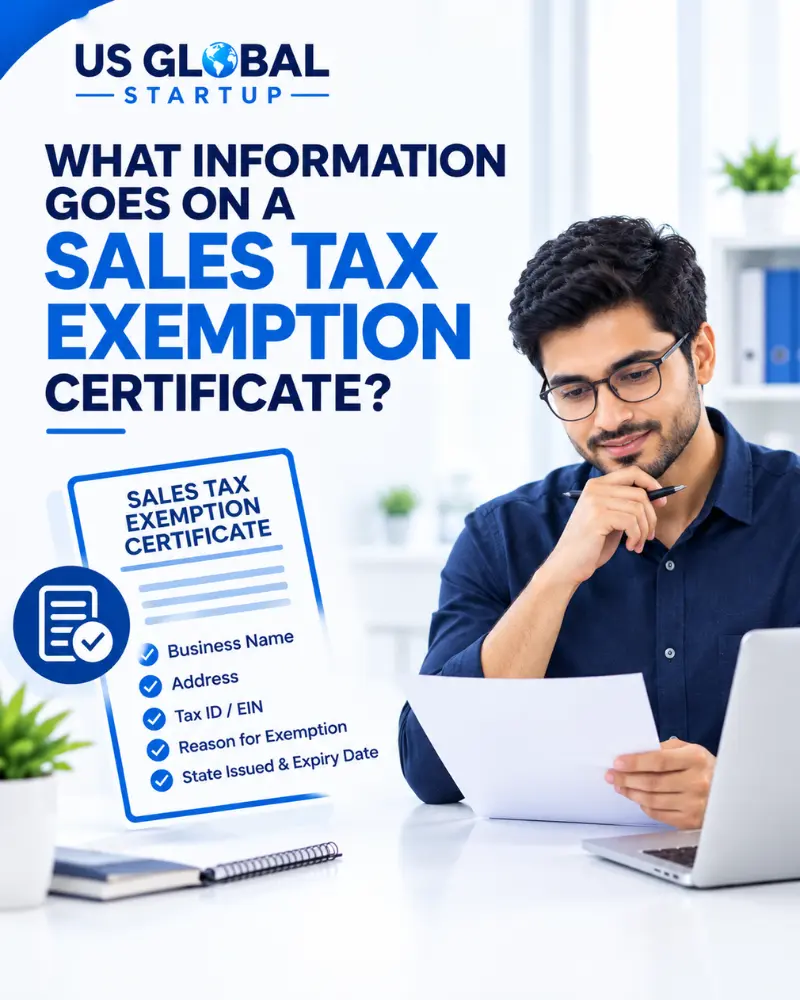
What Information Goes on a Sales Tax Exemption Certificate?
A sales tax exemption certificate typically includes:
- Buyer’s business name and address (your LLC or Inc)
- Seller’s business name and address (the wholesaler/vendor)
- EIN (and ITIN, if applicable for non-residents)
- State sales tax permit/registration number
- Type of exemption claimed (resale, manufacturing, nonprofit, etc.)
- Description of goods being purchased
- Signature, name, and title of the authorized person, plus the date
Some states also ask for the buyer’s industry/business type (e.g., retailer, wholesaler) to confirm the exemption reason makes sense.
Even minor mismatches – like the entity name on the certificate not matching your EIN letter exactly, or a missing sales tax permit number – are common reasons wholesalers reject a Sales Tax Exemption Certificate for Resellers instead of accepting it and fixing it later. Suppliers aren’t required to correct your paperwork; if the certificate looks wrong, most will simply charge you sales tax and leave you to request a refund yourself.
Sales Tax Exemption CertificateCost
Fast Turnaround Per Certificate
Each certificate is completed within 24 hours, so you're not left waiting to make tax-exempt purchases.
Vendor Pushback Support
If a seller questions or refuses your certificate, we provide the documentation and citations needed to support its validity.
Ready To Hand To Vendors Or Sellers
You receive a completed, signable certificate you can hand directly to a vendor or seller to stop sales tax being charged.
Renewal & Expiration Tracking
Some states expire certificates after 1–5 years. We track the date so you're not caught buying inventory without a valid exemption.
Sales Tax Exemption Certificate - Filing Charges
- State-specific exemption certificate preparation
- Exemption basis review & selection
- Non-resident status documentation
- Signable, vendor-ready certificate
- Additional states available at same rate
- Digital copy delivered for your records
Sales Tax Exemption Certificate vs Resale Certificate: What's the Difference
These two terms are often used interchangeably, which is where most confusion starts. The difference is important because using the wrong one can lead to rejected or delayed applications.
| Sales Tax Exemption Certificate | Resale Certificate |
|---|---|
| Broad category covering multiple exemption types (resale, nonprofit, manufacturing, government) | One specific type of exemption certificate |
| Used by nonprofits, manufacturers, resellers, and government buyers | Used only by businesses buying goods to resell |
| Eligibility depends on the buyer's category | Eligibility depends on the intent to resell the goods |
| May not require a sales tax permit in every state | Almost always requires an active sales tax permit number first |
For example, a founder importing skincare products to resell on Amazon and a nonprofit buying office supplies for its own use may both have an exemption certificate, but they are not the same. If the wrong certificate is given, the supplier may simply charge sales tax. This is why a Sales Tax Exemption Registration Service should confirm the correct category upfront instead of using a generic template and hope the state accepts it..
Resale Certificate for LLC vs Resale Certificate for Inc
States don’t treat these two entity types exactly the same on the application form.
Resale certificate for LLC
Most states ask for the LLC’s operating agreement or Articles of Organization, member details, and EIN. Single-member and multi-member LLCs may be asked for different supporting documents. For a resale certificate for non US residents, additional ownership or identification details may also be required.
Resale certificate for Inc
States generally ask for Articles of Incorporation, officer details, and sometimes a corporate resolution authorizing the application. Some states also ask whether the corporation is foreign-owned, which can affect the review timeline.
Can a Foreign Company Get a US Sales Tax Exemption Certificate?
Yes. A foreign-owned LLC or Inc, wholly owned by non-residents, can get a resale certificate for non US residents as long as the company is registered in the US, has a valid EIN, and meets the state’s nexus or registration requirements. Citizenship and residency of the owners are not disqualifying factors. What matters is that the business entity is properly formed and registered with the state’s tax authority.
This is where many DIY applications fail. Founders assume they need an SSN, but in most states, an EIN is sufficient. For example, California may also require an ITIN for the responsible party.
Who Needs This Sales tax exemption certificate filing service?
If your business fits any of the profiles below, filing for a sales tax exemption certificate before your next inventory purchase can help you avoid paying tax that you may not easily recover later. Our sales tax exemption certificate for foreigners makes the process easier by guiding you through the required steps.
- Non-resident e-commerce sellers buying inventory in wholesale to resell on Amazon, Walmart, Shopify, or their own store.
- Import/export businesses purchasing goods in the US that are shipped or resold to a third party.
- Dropshipping and 3PL businesses that take title to goods briefly before they are resold.
- Manufacturers buying raw materials or components that go into a finished product for sale.
- Multi-state sellers with inventory or nexus in more than one state who need a Sales Tax Exemption Certificate for Resellers that valid across each of those states.
If you’re not sure which of these applies to you, the entity and nexus review in Step 1 will help determine that before we file anything. If you’re moving from generic reselling to your own branded product line, it’s also worth securing your brand name early with our trademark registration service in USA. Buying tax-free while building an unprotected brand can create a gap.
What Documents Do I Need for a Sales Tax Exemption Certificate?
- Articles of Organization (LLC) or Articles of Incorporation (Inc)
- EIN confirmation letter (CP 575 or 147C)
- Sales tax registration number
- Owner/member or officer details - Name, Title, Email and Phone number & ITIN if applicable
- US business address (registered agent address is generally accepted)
- Description of the goods being purchased and how they'll be resold
- Prior exemption certificates, if renewing or adding a new state
Step-By-Step Process: Sales Tax Exemption Certificate Service for Non Residents
From confirming which certificate you need to preparing a signed, supplier-ready multistate sales tax exemption certificate, here’s How to Get a Sales Tax Exemption Certificate as a Non Resident and how the process works from your side.
Step 1: Share Your Business Details
Tell us your entity type, the state(s) you buy or sell in, and whether you already hold a sales tax permit. This decides whether we’re filing a fresh application or a multi-state sales tax exemption certificate service request.
Step 2: We Confirm the Right Certificate Type
We check whether a resale, manufacturing, or general exemption certificate applies to your business, and whether the state requires an active sales tax permit first.
Step 3: Application Preparation
We prepare the state-specific form using your EIN, entity documents, and owner information includes name, title, E mail and phone number. The form is completed according to the requirements of that state’s Department of Revenue.
Step 4: Review & Sign-Off
You review the completed application before anything is submitted. We confirm details are correct so there’s no back-and-forth with the state later.
Step 5: Filing and Delivery
We file with the relevant state authority and deliver your signed, ready-to-use certificate, along with instructions on how to provide it to suppliers.
How Long Does It Take to Get a Sales Tax Exemption Certificate?
The turnaround time and required documents for a sales tax exemption certificate for non residents vary from state to state. In general, the process may take 2 to 3 business days when all required information is submitted on time. We let you know the expected timeline and document requirements before the application starts, so you know what to expect.
What Do I Need to Add Before Sending the Sales Tax Exemption Certificate to My Supplier?
As the purchaser, your business information will already be in the form, including the Purchaser’s Name, Type of Business, Address, Printed Name, Signature, Telephone Number, Sales Tax Number (if required), Title, and Email.
You only need to enter the supplier’s details:
- To: Supplier Name
- Date
- Supplier’s Address
- City
- State
- ZIP Code
Once completed, you can send the certificate to the supplier. The supplier can then use it to process your purchase without charging sales tax when the purchase qualifies for the exemption.
Sales Tax Exemption Certificate Expiration & Renewal
This is where many businesses get caught off guard. Certificate validity varies from state to state:
- Some states, like California, allow a resale certificate to remain valid as long as the underlying permit stays active.
- Other states have a fixed validity period, commonly 1, 3, or 5 years, and require renewal with updated business information.
- Some states require the certificate to be reissued when your business address, ownership, or entity structure changes. For businesses operating in multiple states, our multi-state sales tax exemption certificate service helps manage these requirements.
We also track your certificate status and renewal dates, so sales tax exemption for non US citizens stays easier to manage. You’ll know when your certificate needs to be renewed or updated, helping you avoid last-minute issues or delays when purchasing inventory from wholesalers.
What Happens If You Misuse a Sales Tax Exemption Certificate?
Using a certificate to buy items you don’t actually resell – such as office supplies, equipment for your own use, or personal purchases – is misuse, and states take it seriously. Consequences can include:
- Back taxes on the misused purchases, plus interest.
- Penalties charged to the business, and sometimes personally to the responsible party.
- Revocation of the certificate, which can also lead to a broader sales tax audit.
A resale certificate covers goods intended for resale, not everything your business buys. If you’re unsure whether a purchase qualifies, our sales tax exemption registration service can help you confirm the correct exemption before using the certificate.
Sales Tax Exemption Certificate vs Sales Tax Permit: Do You Need Both?
A Sales Tax Permit, sometimes called a seller’s permit, registers your business with a state to collect and remit sales tax on your sales. A sales tax exemption certificate is what you give to your supplier so you don’t pay sales tax when buying inventory.
In most states, you need the permit first because it helps make your exemption certificate valid. If you need an expedited sales tax exemption certificate, then our Fast sales tax exemption certificate service can handle the registration. We can also bundle both services, so you don’t have to file two separate applications with two separate timelines.
Do Non US Residents Qualify for Sales Tax Exemptions?
Yes. Sales tax exemptions are generally based on the business entity and the type of purchase, not the citizenship or residency of the owners. A non-resident-owned LLC or Inc can qualify in the same way as a domestic business, as long as the entity is properly registered, has a valid EIN, and meets the state’s permit requirements.
For non-residents, the main challenge is often the paperwork. Some forms require an SSN, or state portals may be designed for US-based signers, which can make the process more difficult. A Sales Tax Exemption Certificate Application Service designed for non-resident owners, so they can apply by using the correct EIN and ITIN information and making sure the application is completed correctly.
Why Choose US Global Startup To Get Sales Tax Exemption Certificate Service For Non-Residents in USA?
Many exemption certificate services give non-residents the same form used by domestic buyers, which can lead to issues when the state asks for an SSN the founder doesn’t have. Our sales tax exemption certificate service for non-residents is designed around EIN and ITIN-based filings from the start. We also handle multi-state applications under one service and track renewal dates to help prevent your certificate from expiring unexpectedly.
Whether you need a resale certificate for LLC, a resale certificate for Inc, or exemption registration across several states, we handle the complete filing process – not just the form.
How to Verify if an Exemption Certificate is Valid and Current?
Before accepting a certificate or relying on one you already hold, you should do a quick check to help avoid problems later
- Check the expiration date against your state's actual rule - Florida's resale certificate renews every December 31, while California's does not expire as long as the underlying seller's permit stays active.
- Check the permit number through the state's official lookup tool - Most states, including Texas and California, offer an online tool to verify mumber, instead of relying only on the information shown on the certificate.
- Confirm the entity name, address, and EIN match your current state filing - An address or business information change that was not updated on the certificate can cause problems.
- Check that the exemption type still fits the purchase - A resale certificate does not cover goods bought for your business's own use, even if the certificate is still active.
An invalid certificate may not be caught at checkout and could cause problems during a later audit. Taking a few minutes to check it now can help you avoid issues later.
Frequently Asked Questions
Common question about sales tax exemption certificate for non residents in USA
How to Get a Sales Tax Exemption Certificate as a Non-Resident?
Form your US LLC or Inc, get your EIN (an ITIN isn't always required - an EIN is often enough), and then apply for the state's resale certificate using your business documents instead of an SSN. The process is generally the same as for domestic owners, but non-residents may need to provide different identification details, which is where SSN-focused applications can cause problems.
Do Non-US Residents Qualify for Sales Tax Exemptions?
Yes. Sales tax exemptions are based on the business entity and the purchase, not the owner's citizenship or residency. A non-resident-owned LLC or Inc can qualify in the same way as a domestic business, as long as it is properly registered and has a valid EIN. The paperwork may be different for non-residents, but the eligibility is generally the same.
Can Foreign Workers Get Sales Tax Exemptions in the USA?
No - not as individuals. Sales tax exemptions apply to a business making a qualifying purchase, such as buying goods for resale, not to a person's employment or immigration status. A foreign worker buying something for personal use generally pays the same sales tax as anyone else. An exemption may apply only when they are purchasing on behalf of a registered business that qualifies for the exemption.
How to Request an Exemption Certificate from Your Customer?
Ask for the certificate before the sale, not after. In many states, the certificate must be on file when the transaction takes place for the sale to qualify as tax-exempt.
Give the customer the correct form for your state, or the multijurisdictional form if they purchase from you in several states. Before treating the sale as tax-exempt, check that the entity name, permit number, and signature are complete. An incomplete or unsigned certificate may not protect you if the state audits the sale later.
Can You Get a Sales Tax Refund Without an Exemption Certificate?
Rarely. You generally need to get the exemption certificate first and then apply it retroactively - either by asking the seller to refund the tax and correct their filing, or by filing a refund claim directly with the state.
Some states do not accept a certificate obtained after the purchase as valid proof for a past transaction, so the refund may be denied. Getting the certificate before you buy is the safer option; after-the-fact refunds depend on your state's rules.
Do marketplace sellers (Amazon, Walmart) still need a resale certificate if the marketplace collects sales tax for me?
Yes, for your wholesale purchases. Marketplace facilitator laws mean Amazon collects tax from your customers on your behalf. That is separate from the sales tax you may need to pay your supplier when buying inventory. You still need the certificate for the buying side.
Do digital goods or SaaS resellers need a sales tax exemption certificate?
Only in states that tax digital goods or SaaS to begin with - and that varies widely. If the state does not tax the digital product, there is nothing to be exempt from, so no certificate is needed for that item.
What Tax ID Do Non-Residents Need to Claim Sales Tax Exemptions?
An EIN is required in almost every state. It is the number linked to your LLC or Inc and is used on the exemption certificate application. An ITIN is only needed if a specific state's form asks for the responsible party's personal tax ID in addition to the business EIN. It is not a universal requirement, so you generally don't need to apply for one unless the state's form requires it.
Can Contractors Use Client Exemption Certificates for Materials?
Generally, no. A client's exemption certificate covers purchases the client makes directly. It does not automatically apply to a contractor buying materials on the client's behalf, even for the same project.
In most states, contractors are treated as the end users of the materials and must pay sales tax upfront, unless the state has a specific exemption or direct-pay rule that applies to the project.
Do I need a separate exemption certificate for every supplier, or just every state?
Every supplier, technically - but you don't need to refile with the state each time. Once you have a valid state certificate, you give a copy to each new supplier you buy from in that state. The state issues the exemption; the supplier just needs proof of it on file.
Does an exemption certificate cover shipping and freight charges too?
Depends on the state. Some states tax shipping as part of the sale unless it is separately stated and the goods themselves are exempt. Others may tax freight regardless of the underlying exemption.
This is state-specific, so it is better to confirm the rule instead of assuming your certificate covers the full invoice.
My supplier rejected my resale certificate - why?
Usually, one of four things causes the problem: the entity name does not exactly match your EIN letter, the permit number cannot be verified through the state's lookup tool, the certificate is for the wrong state, or you are not eligible for the exemption. This is a common mistake when a supplier ships from a different state than the one where your business is registered.
Can a single-member LLC use the owner's SSN instead of the LLC's EIN?
Not recommended. Even though the IRS treats a single-member LLC as a disregarded entity for federal tax purposes, most state Departments of Revenue want the exemption certificate tied to the business's own EIN and permit number, not the owner's personal SSN.
What if I lose my exemption certificate - can I get a replacement?
Yes. Since the certificate is tied to your permit number on file with the state, you can usually request a reissued copy or reprint it from the state's online portal instead of applying from scratch. However, you'll need your permit number to do this.