

Online LLC Operating Agreement Service For Single Member & Multi Member LLC
Operating Agreement Service For LLC Starting From $50 View Pricing →
Everything Included In OurOperating Agreement Service For LLC
Ownership & Management Structure Review
Ownership & Management Structure Review Confirming member-managed vs. manager-managed structure, and how ownership is actually split
Custom Operating Agreement Service
Drafted correctly whether you're a single-member LLC or a multi-member LLC, with the right clauses for each.
Ownership Percentage & Capital Contribution Documentation
Clear terms on who owns what, and what each member contributed to get started
Amendment Support
If your ownership, state, or structure changes later, we update the agreement to match
Digital Delivery & Signature Guidance
A properly executed, ESIGN Act-compliant document ready to hand to your bank or partners
Operating Agreement For LLC
🔒 Your information is secure. No spam, ever.
Most states don’t legally require an LLC to have an operating agreement — but almost every bank expects one when reviewing your business documents. If you’ve completed LLC registration in USA in a privacy-friendly state like Wyoming or Delaware, your name may not appear on the public formation record, making your Operating Agreement an important document for establishing your ownership and management rights.
Our LLC Operating Agreement Services cover both operating agreements for single-member LLCs and operating agreements for multi-member LLCs, custom drafted around your actual ownership, management structure, member responsibilities, and business requirements — not a generic fill-in-the-blank template.
What Is an LLC Operating Agreement?
An LLC operating agreement is an internal document that explains your company’s ownership structure, member roles, profit and loss sharing, decision-making authority, and what happens if the business is dissolved. Unlike your Articles of Organization, it is generally not filed with the state. Instead, it is kept with your company records and helps banks, payment processors, and courts understand who owns and controls the LLC.
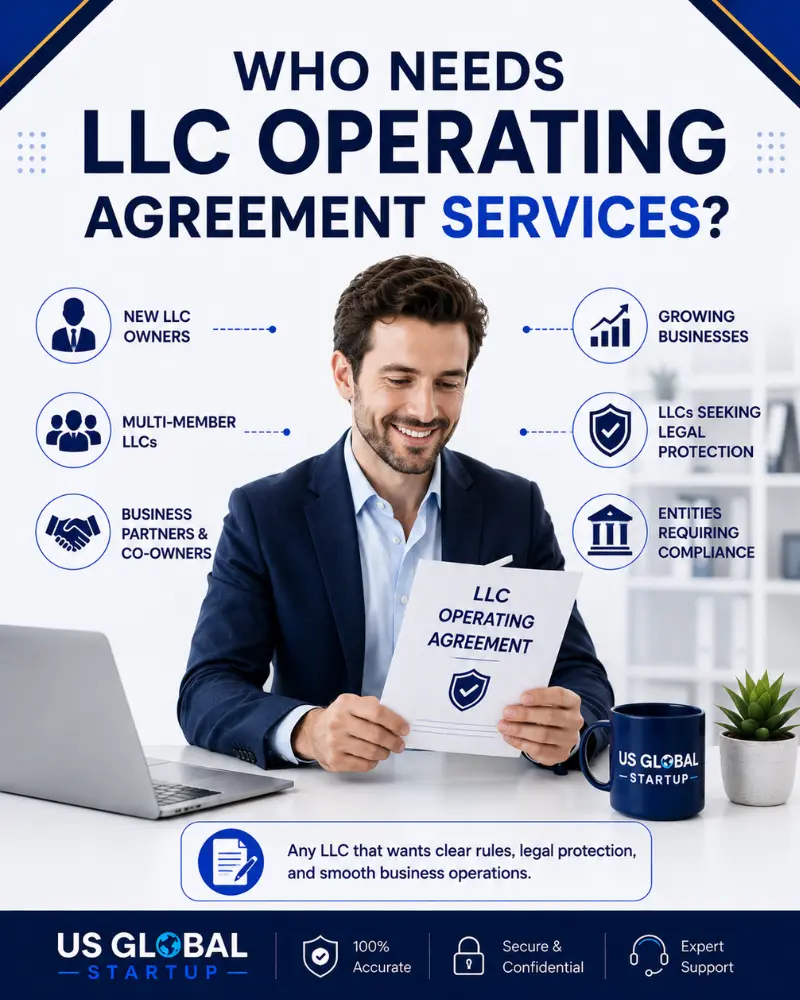
Who Needs Our Operating Agreement Services For LLC, And Why
You need this whether you’re a single owner or have partners involved:
- Single-member LLC owners – especially in Wyoming, Delaware, or other privacy-focused states where your name doesn’t appear on the public formation record
- Multi-member LLCs needing clear ownership percentages, profit/loss allocation, and decision-making authority documented before disputes have any chance to arise
- Foreign-owned and non-resident LLC owners who need this document specifically to satisfy US bank and payment processor requirements
- LLCs bringing on a new member or restructuring ownership, where the existing agreement needs updating to reflect the change
- LLCs preparing to open a US bank account for the first time, since this is one of the most commonly requested documents during onboarding
How Much Does an Operating Agreement Actually Cost?
Ownership & Profit Split Spelled Out
Member ownership percentages, capital contributions, and profit/loss allocation are documented clearly for every member.
Management & Voting Rules Covered
We define whether the LLC is member-managed or manager-managed, plus voting rights and decision-making authority.
Exit & Transfer Terms Included
Clear terms for a member leaving, passing away, or transferring their stake, so disputes don't end up in court.
Protects Your Liability Shield
A signed agreement helps protect your LLC’s limited liability by separating personal and business assets.
100+
LLCs served
120+
Operating Agreements drafted
Operating Agreement — Drafting Charges
- Custom Operating Agreement drafting
- Single-member & multi-member structuring
- Buyout & dispute-resolution clauses
- Capital contribution & profit-split terms
- Foreign-owned / non-resident provisions
- Editable file + signed copy delivered
- Bank-ready formatting
Operating Agreement vs. Articles of Organization: What's the Difference?
These two documents get confused constantly, so it’s worth being direct about the operating agreement vs articles of organization difference, especially when preparing an operating agreement online.
| Comparison | Articles of Organization | Operating Agreement |
|---|---|---|
| Filed with | Filed with the Secretary of State to legally form the LLC | Never filed anywhere - kept privately in your company records |
| Public record? | Publicly searchable on the state's business registry | Not accessible to the public, ever |
| What it establishes | That the LLC legally exists | Who owns it, how it's run, and what happens in disputes or exits |
| Contains member names/ownership %? | Not in privacy states (Wyoming, Delaware, New Mexico) | Always lists exact ownership percentages and member details |
This is why the operating agreement is important for non-resident founders. In privacy-focused states, the Articles of Organization may not show who owns the company, while the operating agreement provides that ownership information. Understanding the operating agreement vs articles of organization difference can also help when a bank asks for specific company documents.
Operating Agreement for Single-Member LLC vs. Multi-Member LLC
The main purpose is the same, but the details included can be different.
Operating agreement for single-member LLC:
- Confirms that the sole member owns 100% of the LLC and has full signing authority.
- Simpler in structure, but still useful for banking and keeping the LLC separate from the owner.
- Especially important in privacy-focused states where the owner may not appear in public records.
Operating agreement for multi-member LLC:
- Documents each member's exact ownership percentage and capital contribution
- Explains how profits and losses are shared.
- Defines voting procedures, management structure, and what happens if a member wants to exit
- It serves as an operating agreement between partners, clearly defining each partner's rights, responsibilities, and ownership to help prevent future disputes.
LLC Operating Agreement Ownership Percentage: How to Set It Correctly
The operating agreement ownership percentage section is important for showing who owns and controls the LLC. It can also help avoid confusion if a member leaves or ownership changes.
- Ownership percentage and profit/loss allocation don't have to match. Members can agree to split profits differently from their capital contribution percentage, as long as it's clearly mentioned
- Capital contributions should be recorded precisely - cash, property, or services contributed, and their value at the time
- Changes in ownership (a member leaving, a new member joining, or percentages shifting) should be documented through an amendment to the operating agreement.
Operating Agreement for Foreign-Owned LLC: Why Banks Ask for This
If you’re a non-resident founder, an operating agreement for foreign-owned LLC can be especially important when opening a US business bank account. US banks – including Mercury, Relay, Chase, and Bank of America – review your operating agreement for three things: the list of members, each member’s ownership percentage, and who has authority to open and operate accounts for the LLC. For a single-member LLC, it should clearly state that the sole member has this authority.
Without an operating agreement, a bank may have no official way to confirm that you’re the actual owner of the company you’re opening an account for. Some banks may also ask foreign-owned LLCs for additional proof of US business activity & passport during onboarding process. Hence requirement may vary based on bank.
Operating Agreement Checklist: What Should Be Included? (Single-Member & Multi-Member)
Document Required For All LLCs
- Articles of Organization (or Certificate of Formation)
- EIN Confirmation Letter (IRS Form CP 575 or 147C)
- Formation state and formation date
- Registered agent name and address
Document Required For Single Member LLC
- Legal name of member, along with country of residence
- SSN, ITIN, or foreign tax ID (for non-resident owners)
- Capital contribution details (cash, property, or services)
Document Required For Multi Member LLC
- Legal name, address, and SSN/ITIN/foreign tax ID for each member
- Ownership percentage for each member, and how it was determined (equal split, capital contribution-based, or another agreed structure)
- Capital contribution amount per member
- Profit and loss allocation terms, if different from straight ownership percentage
- Any specific provisions you want included
LLC Operating Agreement Online Service - Step By Step Guide
From your first document to final signature, here’s exactly how our LLC operating agreement drafting service turns your LLC’s details into a compliant, ready-to-use Operating Agreement.
Step 1: Verify Formation Documents
We review your Articles of Organization or Certificate of Formation and EIN confirmation letter (CP 575 or 147C) to confirm your LLC’s legal name, state, formation date, and EIN.
Step 2: Collect Member Details
We collect each member’s legal name, address, and SSN, ITIN, or foreign tax ID. For an operating agreement for foreign-owned LLC, we also verify the relevant foreign owner information.
Step 3: Confirm Ownership & Management
We document each member’s operating agreement ownership percentage, capital contribution, and management structure. We can prepare an operating agreement for single-member LLC or an operating agreement for multi-member LLC, depending on your business structure.
Step 4: Review Tax Classification
We confirm the LLC’s federal tax classification, including disregarded entity, partnership, or elections made through Form 8832 or Form 2553, so the agreement reflects the correct tax structure.
Step 5: Draft Key Provisions
We prepare the agreement around your LLC’s specific needs, covering ownership, management, voting rights, distributions, member responsibilities, buyouts, dispute resolution, and dissolution.
Step 6: Review & Finalize
You review the draft and request any necessary changes. We make the agreed revisions and prepare the final version for execution.
Step 7: Deliver & Support
Through our operating agreement online service, we provide the completed agreement in editable Word and PDF formats, along with signing guidance. We can also assist with amendments when your LLC’s ownership or structure changes.
How Long Does It Take to Create an Operating Agreement?
Our LLC operating agreement drafting service typically prepares your Operating Agreement within 2 business days after receiving all required information and documents.
Can Business Partners Share One Operating Agreement?
Yes. If they’re members of the same LLC, one Operating Agreement covers all partners. It lists each member’s ownership percentage, capital contribution, rights, and responsibilities, with everyone signing the same document. An operating agreement between partners does not require separate agreements for each person.
Where This Gets Confused:
- Different LLCs, Same Partners: If the same partners own two separate LLCs, each LLC needs its own Operating Agreement.
- Series LLCs: Each series may need its own agreement or dedicated section because members and ownership can differ.
- Side Agreements: Partners may sign separate buy-sell agreements or side letters, but these supplement rather than replace the main Operating Agreement.
Can I Change My Operating Agreement Later?
Yes. You can amend LLC Operating Agreement later when the business, ownership, or management structure changes. The agreement should specify how amendments are approved and documented, and all required members should sign the updated version.
Do I Need to File My Operating Agreement With the State?
No. An Operating Agreement is an internal company document. You keep it with your LLC records and generally do not submit it to the state.
What Happens if You Don't Have an LLC Operating Agreement?
Most states don’t require one, but skipping it doesn’t mean you’re protected – it means your LLC runs on default state rules instead of your own.
State Default Rules Take Over
Without an agreement, your state’s LLC Act (e.g., RULLCA, or your state’s default statute) decides ownership splits, profit distribution, and dissolution terms. Without your own terms, your LLC may be governed by default state rules instead of the rules you and your members agreed to.
Banks May Question Your Account Application
Banks and financial institutions may request an Operating Agreement to verify ownership and signing authority. Without one, your formation documents may not provide enough information for their review.
No Proof of Ownership in Disputes
If a member leaves, passes away, or disputes their share, there may be no internal document clearly establishing the operating agreement ownership percentage, buyout terms, or transfer rights.
Weakens Your Liability Protection
An Operating Agreement helps demonstrate that your LLC has defined governance and operates as a separate legal entity. While having one does not guarantee liability protection, the absence of formal records can create additional complications in a legal dispute.
Equal Split by Default, Regardless of Contribution
Without written terms, state default rules may determine how profits, losses, and distributions are allocated. This can create problems when members contribute different amounts of capital, property, services or even does more of the work.
No Clear Exit or Deadlock Process
Without defined buyout, dispute-resolution, or dissolution provisions, disagreements between members can become more difficult and expensive to resolve, particularly when the LLC reaches a deadlock.
Which States Don't Require an LLC Operating Agreement?
Most states don’t require one. Only five states require an LLC operating agreement: California, Delaware, Maine, Missouri, and New York. The other 45 states don’t have a legal filing or drafting requirement.
How Do Operating Agreements Handle Member Buyouts?
A well-drafted Operating Agreement includes a buy-sell provision that explains the process, price, and payment terms for buying out a member. This helps settle the terms before a dispute happens instead of negotiating under pressure later.
What the buyout clause typically defines:
- Triggering Events - Events that can trigger a buyout, such as voluntary departure, death, disability, divorce, bankruptcy, retirement, or termination for cause.
- Valuation & Ownership - Defines how the member’s share is valued based on the operating agreement ownership percentage, using a fixed price, formula, appraisal, or book value.
- Right of First Refusal - Remaining members usually get the first opportunity to buy a member’s interest before it is sold to an outside party.
- Payment Terms - Defines whether the buyout is paid as a lump sum or installments, such as over 12–36 months, and whether interest applies.
- Funding Mechanism - Some agreements use buy-sell insurance, such as life or disability coverage, to help fund the buyout without creating a cash-flow problem.
- Deadlock Resolution - For 50/50 multi-member LLCs, the agreement may include mediation, arbitration, or a “shotgun clause” to resolve buyout disputes.
How Does an Operating Agreement Affect My Taxes?
The Operating Agreement itself doesn’t set your tax classification – the IRS does that separately – but it defines how profits, losses, and distributions are split among members, which directly affects what each member reports on their tax return. This is also important for an operating agreement for foreign-owned LLC, where ownership and tax treatment need to be clearly documented. The key areas it controls are mentioned below:
- Profit & loss allocation - Specifies each member's share of profits/losses, which doesn't have to match the operating agreement ownership percentage if the agreement states otherwise (subject to IRS "substantial economic effect" rules).
- Distribution timing - Defines when and how profits are paid out to members, separate from when profits are earned or taxed.
- Guaranteed payments - For multi-member LLCs, the agreement can define guaranteed payments for services, which are taxed differently from regular profit shares.
- Tax classification reference - If the LLC has elected S-corp (Form 2553) or C-corp (Form 8832) status, the agreement should reflect that classification, since default pass-through taxation rules no longer apply.
What Happens if Operating Agreement Terms Conflict With State Law?
It depends on the type of rule. Most state LLC statutes have two categories: default rules, which your agreement can override, and mandatory rules, which apply regardless of what your agreement says.
Default Rules - Your Agreement Wins:
- Profit-split ratios, voting thresholds, and management structure are usually default rules. If your agreement addresses them, your terms generally control instead of the state's default.
Mandatory Rules - The State Wins:
- A member's right to information about the LLC's finances
- Fiduciary duties owed to other members, though some states allow narrowing them
- Rights of third parties dealing with the LLC in good faith
- Judicial dissolution rights in cases of fraud or oppression
If Your Agreement Is Silent:
The state’s default rule automatically fills any gap. This is one reason a generic or incomplete agreement can cause problems later.
Why Choose Our LLC Operating Service:
Because state rules vary and some provisions cannot be overridden, it’s better to have your agreement prepared correctly from the start. Our operating agreement service for llc helps you create an agreement customized to your LLC and the laws of your state.
Frequently Asked Questions
Common question about operating agreement for LLC
Can I Use the Same Operating Agreement for Multiple LLCs?
No. Each LLC is a separate legal entity and needs its own Operating Agreement with its specific name, EIN, formation state, and members.
Are Operating Agreements Required for Single-Member LLC?
Yes, but requirements vary by state. A single-member LLC may not be legally required to have an Operating Agreement in many states, but having one helps document ownership, management, and separation between the LLC and its owner.
Does My Operating Agreement Need to Be Notarized?
Generally, no - an LLC operating agreement doesn't need to be notarized to be legally valid in most U.S. states.
Can I Use a Template for My LLC Operating Agreement?
Yes, you can use a template, but it may not cover your LLC’s specific ownership, management structure, and business needs. A professionally drafted agreement can be customized to your situation and help avoid common mistakes.
What Are the Most Important Sections of an Operating Agreement?
The most important sections usually include ownership, member contributions, management structure, voting rights, profit and loss distribution, member responsibilities, transfer of ownership, and procedures for adding or removing members.
Do I Need an Operating Agreement Before or After Forming My LLC?
You can prepare an Operating Agreement after forming your LLC, but it’s best to have it ready as soon as possible. It helps clearly document the LLC’s ownership, management, and operating rules.
How Do I Know If My Operating Agreement Is Legally Valid?
Your Operating Agreement should comply with your LLC's formation state laws and accurately reflect your ownership and management structure. Our team prepares customized Operating Agreements based on your LLC’s specific requirements and business structure.
How Does an Operating Agreement Handle Profit Distribution?
An Operating Agreement explains how profits and losses will be distributed among LLC members based on the agreed ownership and distribution terms.
What Is the Professional Fee for an LLC Operating Agreement?
Our professional fee is $50 for preparing a customized LLC Operating Agreement. We typically complete the agreement within 2 business days after receiving the required information.
What Happens if Operating Agreement Terms Conflict With State Law?
It depends on the rule type. Default rules - such as profit splits, voting thresholds, and management structure - can generally be overridden by your agreement. Mandatory rules - such as a member's right to financial records or certain fiduciary duty protections - apply even if your agreement says otherwise.