

Form 1120-S Filing Service: Accurate S Corp Tax Filing - Done For you
Form 1120-S Filing Service Starting From $350 View Pricing →
Everything Included In OurForm 1120-S Filing Service
S Election Verification
Confirming your Form 2553 was actually accepted by the IRS before we build anything on top of it
Complete Form 1120-S Preparation
The full return prepared from your books - income, deductions, and pass-through items, done properly
Schedule K-1 Preparation Service
One K-1 per shareholder, showing their exact pro-rata share of income, losses, and credits
Reasonable Compensation Review
Ensuring shareholder-employees receive a reasonable W-2 salary before distributions.
E-File Form 1120-S Service
Electronic filing with the IRS and confirmation once your return is accepted
Deadline & Extension Tracking
Your March 15 deadline tracked, with Form 7004 filed for you if an extension is needed
File Form 1120 s For S Corp
🔒 Your information is secure. No spam, ever.
What Is Form 1120-S and Do I Really Need to File It?
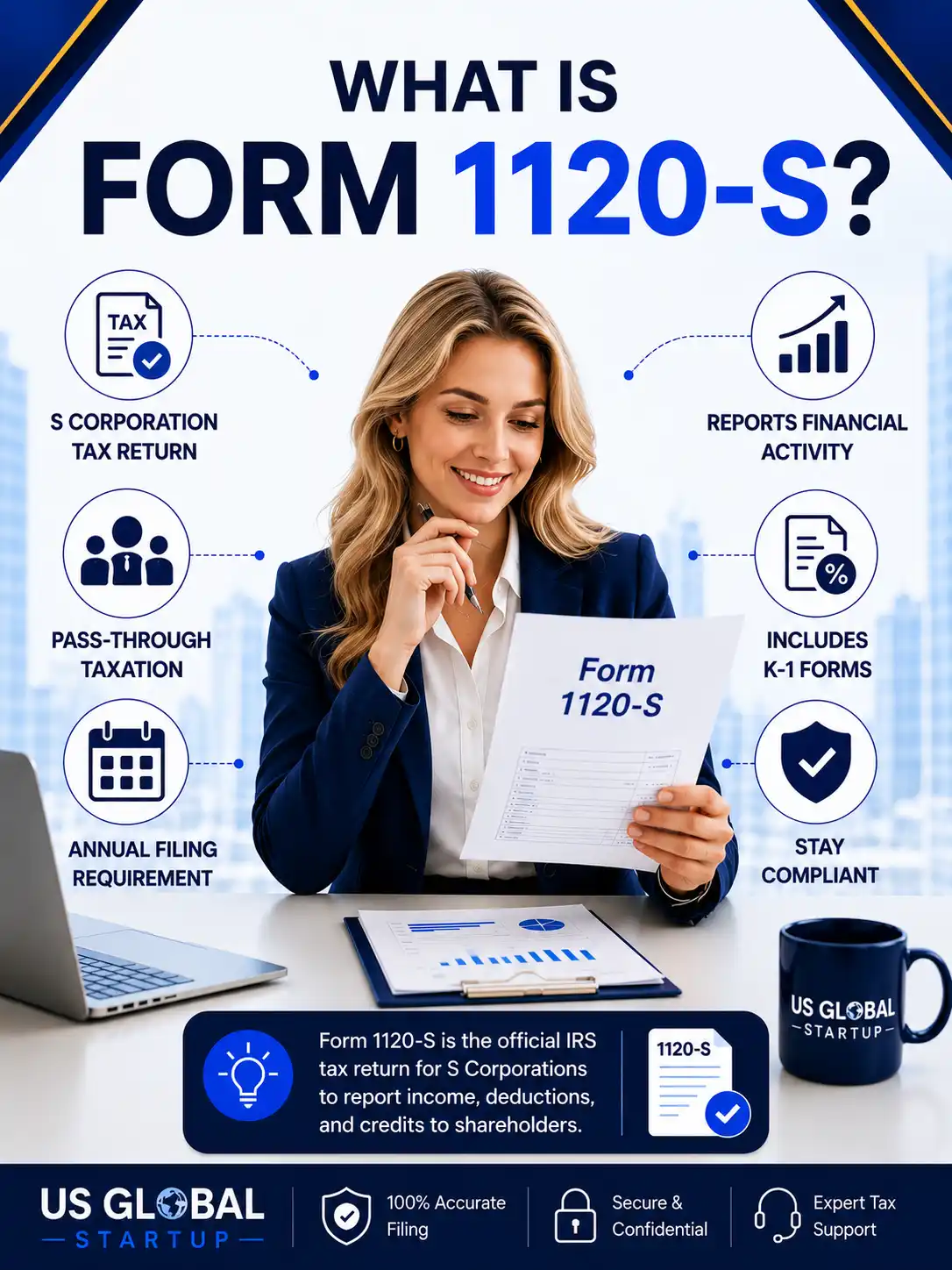
Form 1120-S is the annual federal tax return that S Corporations use to report business income, deductions, and other tax information to the IRS. This S Corp annual return is required if your business has an active S-Corp election (meaning your Form 2553 was filed and approved). You generally need to file it every year, even if your business had no income or was inactive.
Unlike a C-Corporation return, Form 1120-S does not calculate federal income tax at the corporate level. Instead, it reports each shareholder’s share of income, deductions, and credits through Schedule K-1, which shareholders use to report their share on their own personal tax return.
Can a Non-Resident Own an S Corporation?
This is one of the most important S-Corp rules to understand: S Corporations cannot have non-resident alien shareholders. Unlike an LLC or a C-Corporation, both of which allow 100% foreign ownership, S Corp eligibility rules restrict shareholders to US citizens, resident aliens, and certain qualifying trusts and estates. A non-resident alien holding even a single share, directly or through certain trust structures, then IRS terminates the S election entirely.
If you’re a non-resident entrepreneur, an LLC or C-Corporation is usually the better option. Our Form 1120-S filing service is designed for businesses that meet the IRS eligibility rules for S-Corporation status.
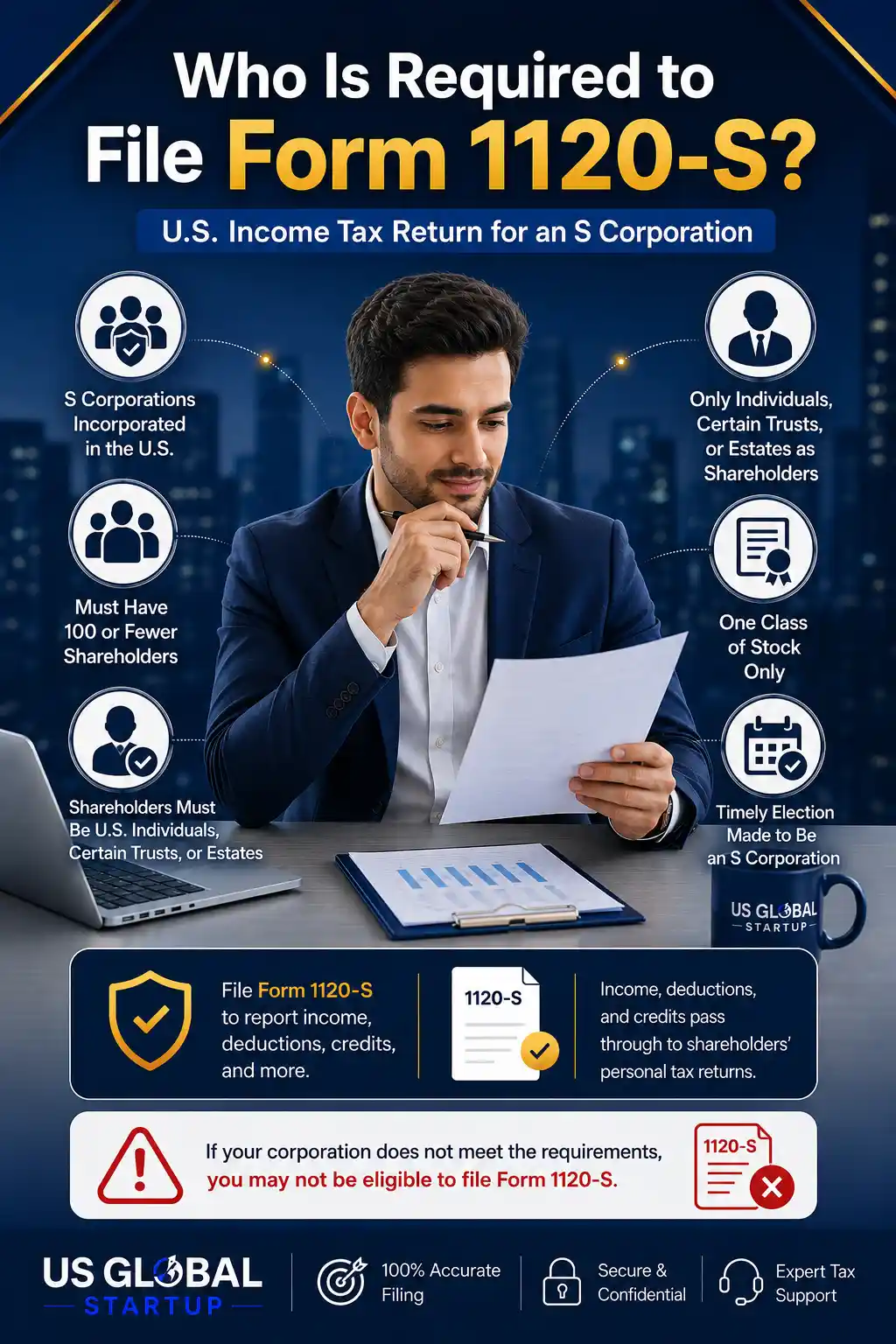
Who Is Required to File Form 1120-S?
You need our Form 1120-S filing service if any of these apply to your business:
- Any corporation or LLC that has elected S Corporation status by filing Form 2553 and needs to prepare Form 1120 S.
- S-Corps with shareholder-employees who need reasonable W-2 compensation and proper payroll reporting.
- S-Corps with no income or business activity during the year, as they still have a filing requirement.
- S-Corps with a late or incorrect S-Corp election that needs to be resolved before filing.
- Multi-shareholder S-Corps that require accurate Schedule K-1 allocations based on ownership.
What's the difference between Form 1120-S and Form 1120?
Form 1120-S is the tax return used by S-Corporations. It is generally a pass-through return, meaning the corporation itself usually does not pay federal income tax. Instead, income, deductions, and credits pass through to shareholders, who report their share through K-1 income reporting on their personal tax returns.
Form 1120 is the tax return used by C-Corporations. Unlike an S-Corp, a C-Corp pays federal corporate income tax at the entity level, and shareholders may also pay tax when profits are distributed as dividends. The right filing depends on your corporation’s tax election and ownership structure.
How Much Does It Cost to File an S-Corp Tax Return?
Every Return Reviewed By a Licensed CPA
Your return and every shareholder's K-1 are reviewed by a licensed CPA.
Right Schedules, Right Basis Forms, Every Time
We prepare all required schedules, including Schedule K-1, Schedule L, M-1, and M-2.
Salary vs. Distribution, Checked Properly
We review how shareholder-employees split pay between W-2 salary and distributions.
Priced For How Your S-Corp Actually Runs
Pricing is based on your S-Corp's size, activity, and filing complexity.
One Less Way to End Up With an IRS Notice
Filed accurately and on time, for the business and for every shareholder relying on their K-1
30+
1120 S Form Filed
100%
E-Filed With IRS
Form 1120-S Filing Charges
- S-Corp filing status review
- Form 1120-S preparation (all applicable schedules)
- Schedule K-1 preparation for every shareholder
- Shareholder basis review (stock & debt)
- K-2/K-3 reporting (where applicable)
- Deadline & extension (Form 7004) tracking
- Late S election (Form 2553) relief support
- Prior-year missed return catch-up filing
Form 1120-S vs Schedule C: Key Differences
For many business owners, the real comparison isn’t S-Corp vs C-Corp – it’s S-Corp vs staying a sole proprietor filing Schedule C. The biggest difference is self-employment tax, so it’s important to look at the actual numbers rather than simply assuming an S-Corp always saves money. When you file S Corp tax return, understanding this difference helps determine whether an S-Corp election is the right choice for your business.
| Comparison | Form 1120-S (S-Corp) | Schedule C (Sole Proprietorship) |
|---|---|---|
| Filed with | Separate corporate return, plus Schedule K-1 to owner | Personal Form 1040 (or 1040-NR for non-residents) |
| Self-employment/payroll tax base | Only the W-2 salary portion (reasonable compensation) | 100% of net profit |
| SE/payroll tax rate | 15.3% total FICA, split 7.65% employer / 7.65% employee, on wages only | 15.3% (12.4% Social Security up to the annual wage base + 2.9% Medicare, no cap) |
| Distributions taxed as SE income? | No - distributions above reasonable salary avoid the 15.3% entirely | N/A - there's no separate "distribution," it's all one number |
Can I Deduct Owner Salaries on My S-Corp Return?
Yes. Reasonable compensation paid to shareholder-employees is a deductible business expense on Form 1120-S, similar to regular employee wages. Getting this amount right is important when you file Form 1120-S online, because it affects both the corporation’s deduction and the shareholder’s taxable income.
- Salary is deducted at the corporate level, reducing pass-through income : If your S-Corp earns $150,000 and pays $60,000 in reasonable salary, only $90,000 passes through to shareholders through Schedule K-1.
- Distributions are not a deductible expense : Only actual W-2 wages qualify as a deduction. Profit distributed to shareholders above their salary is not a business expense; it is simply their share of already taxed (or pass-through) profit.
- Salary must be reasonable: : For the work performed and not minimized purely to reduce payroll tax. The IRS scrutinizes most closely in S-Corp audits, which is why we carefully check reasonable compensation as part of our 1120-S tax preparation before filing your return.
- Payroll taxes on the salary are also deductible: : The employer's share of FICA (7.65%) paid on shareholder wages is also a deductible business expense, separate from the wage deduction.
Choosing the right salary amount is not just about compliance—it directly affects your corporation’s taxable income and each shareholder’s K-1. This is why our 1120-S tax preparation for S corporation service includes a review of shareholder compensation before filing.
Documents Required To File Form 1120 S For S Corp
- Accepted Form 2553 (or confirmation of acceptance) showing your S election is valid
- EIN confirmation letter
- Full financial records for the year - income, expenses, and balance sheet
- Shareholder details, including names, addresses, SSNs, and ownership percentages
- Payroll records for shareholder-employees, including W-2s
- Prior year's Form 1120-S and Schedule K-1s (if applicable)
- Details of any shareholder distributions made during the year
Step-by-Step: How Our Form 1120-S Filing Service Works
Our S Corp tax filing service handles everything from S election review to return preparation and filing, including Schedule K-1 preparation service for shareholders.
Step 1: Confirm Your S Election Status
We verify your Form 2553 was actually accepted, and resolve any late-election issues before proceeding.
Step 2: Share Your Financial Information
Provide your shareholder Details Books, payroll records, and each shareholder’s ownership percentage.
Step 3: We Prepare Your Full Return
Form 1120-S, Schedule K-1 for each shareholder, and K-2/K-3 where international items apply.
Step 4: Reasonable Compensation Review
We confirm shareholder-employees have a defensible W-2 salary in place before any distributions.
Step 5: Review & Approval
Review your completed return before it’s submitted to the IRS.
Step 6: E-File & Confirmation
Using our e-file Form 1120-S service, we electronically file your return with the IRS, confirm acceptance, and provide Schedule K-1s to all shareholders.
How Long Does It Take to Prepare an S-Corp Tax Return?
Most simple S-Corp returns are completed within 7 business days after receiving all documents. Our S Corporation tax return filing service includes additional review for returns with multiple shareholders, basis tracking, or prior-year issues, which may require more time.
Form 1120-S Deadline and Extensions
- March 15 - Standard filing deadline for calendar-year S-Corps (or the 15th day of the 3rd month after the tax year ends). This is also the deadline to provide Schedule K-1s to shareholders.
- September 15 - Extended filing deadline available by submitting Form 7004 before the original due date.
- The extension only gives more time to file. Any tax owed at the entity level is still due by the original deadline.
What Happens If You File 1120-S After the Deadline?
Missing the S Corp filing deadline without an extension can trigger penalties that increase quickly, as they are charged per shareholder, per month:
- Late filing penalty – Around $220 – $255 per shareholder, per month or partial month late, up to 12 months (rates may change).
- Example: An S-Corp with 5 shareholders filing 3 months late may face penalties of about $3,300 – $3,825, even if no tax is due.
- Late K-1 penalty – A separate penalty may apply if shareholders don’t receive their K-1s on time.
- No relief for $0 tax owed – Penalties can still apply even if the return shows no tax due.
If you’ve missed the deadline, you should file 1120-S after deadline as soon as possible. Since penalties apply monthly, every additional month can increase the amount owed.
Do Single-Member S-Corps Have Different Filing Requirements?
Not really. A single-member S-Corp still files Form 1120-S and issues one Schedule K-1 to the sole shareholder, just like a multi-shareholder S-Corp. The main filing requirements remain the same. The only difference is that the filing process is usually simpler because there is only one shareholder and one Schedule K-1 to prepare.
How Do I Calculate My S-Corp Basis for Tax Purposes?
Your S-Corp basis determines how much loss you can deduct and whether distributions are tax-free or taxable. It is tracked in two categories:
- Stock Basis: Starts with your investment, increases with income, and decreases with distributions, losses, and certain expenses. It cannot go below zero.
- Debt Basis: Created only by loans you personally make to the S-Corp. It may allow additional loss deductions after stock basis reaches zero.
Failing to track basis correctly is one of the common S Corp tax mistakes that can lead to incorrect deductions and IRS issues. Keeping your basis updated each year helps ensure accurate tax reporting.
What Are Self-Employment Taxes for S-Corp Owners?
S-Corp owners don’t pay self-employment tax the same way sole proprietors or partners do. Instead, only their W-2 salary is subject to payroll (FICA) tax, split between the employer and employee at 7.65% each.
Profit distributions above the salary amount are generally not subject to self-employment tax or payroll tax, which is one of the key benefits of S-Corp status. When you File Form 1120-S online, it’s important to report salary and distributions correctly to avoid IRS issues.
However, the salary must be reasonable based on the work performed. If it is set too low to reduce taxes, the IRS may reclassify some distributions as wages and apply additional payroll taxes and penalties. Our Form 1120-S filing service helps ensure your return is prepared correctly.
Why Outsource 1120-S Filing Instead of Using Tax Software?
Tax software can work for simple S-Corp returns with no complications. However, it may not identify issues like reasonable compensation, late S-Corp election Form 2553 help, K-2/K-3 international reporting, or an invalid S-Corp election due to ownership restrictions.
If you prefer to outsource 1120-S filing, our service helps ensure these important compliance areas are reviewed and handled correctly before filing.
Other Tax Filings You May Need Alongside Form 1120-S
Depending on your business structure and tax situation, you may also need:
- Form 1040-NR Filing – If you have a separate individual filing requirement as a non-resident taxpayer receiving US-source income.
- Form 1065 Filing – If you also operate a multi-member LLC or partnership.
- Form 1120 Filing – If you need to file a prior C-Corp return or are comparing C-Corp and S-Corp structures.
- US Federal Tax Return Filing – For additional federal compliance requirements beyond your S-Corp return.
If your business involves multiple entities or filing requirements, reviewing everything together helps keep income reporting, ownership details, and tax records consistent.
Frequently Asked Questions
Common question about Form 1120 S for S Corp filing
How to organize receipts and records for S-Corp filing?
Keep a separate business bank account and credit card so transactions don't mix with personal spending - that alone solves most of the sorting problem. Organize receipts by month and category (payroll, rent, supplies, professional fees, etc.), and keep payroll records, K-1s, and prior-year returns in one folder. Digital copies (scanned or photographed) are acceptable and easier to keep organized than paper.
What Are the Most Common S-Corp Tax Mistakes to Avoid?
The most common S-Corp tax mistakes include paying yourself an unreasonably low salary to reduce payroll taxes, missing the March 15 Form 1120-S deadline, failing to track shareholder basis correctly, mixing personal and business expenses, and filing Form 1120-S before confirming that Form 2553 was accepted by the IRS. Avoiding these mistakes helps prevent compliance issues and IRS notices.
What Is the 2% Rule for S Corporations?
S-Corp shareholders who own more than 2% are treated differently from regular employees for certain fringe benefits. Benefits like employer-paid health insurance must generally be included in the shareholder's W-2 wages as taxable income, although they are usually not subject to FICA/payroll tax. This affects how benefits are reported on the shareholder's W-2 and tax return.
How Do I File Multiple Years of Unfiled S-Corp Returns?
File the oldest missing return first and work forward, since each year's figures and shareholder basis build on the prior year's numbers. Prepare and file all missing returns together where possible, issue the required Schedule K-1s for each year, and check if you qualify for penalty relief (such as First-Time Abatement or reasonable cause) after getting caught up. It is usually easier to request relief once all outstanding returns have been filed.
Do I Need to File State Taxes if I Have an S-Corporation?
Usually, yes. Most states require a separate state-level S-Corp tax return in addition to your federal Form 1120-S, but the rules vary by state. Some states, such as Ohio, Texas, and Nevada, may not follow federal S-Corp treatment and may require different tax filings.
If your S-Corp operates in multiple states, you may need to file state returns in each state where the business has nexus (taxable presence), not only the state where your corporation was formed.
Can I File My S-Corp Taxes Myself or Do I Need a CPA?
You're not legally required to use a CPA - but S-Corp returns are genuinely more complex than a simple 1040, especially around reasonable compensation, basis tracking, and K-1 allocation. DIY software can work for a very simple, single-shareholder S-Corp with no complications, but it's easy to miss things like reasonable compensation documentation or basis limits on losses, which tend to cost more to fix later than they would have to get right the first time.
Why Was My S-Corp Tax Return Rejected by the IRS?
E-file rejections are usually caused by a mismatch - an incorrect EIN, a name that doesn't match IRS records, or a missing/invalid S election on file. Check the rejection code first, since it tells you exactly what didn't match. Fix the specific issue and resubmit; if it's rejected close to the deadline, refiling promptly after a rejection is generally treated as timely, but don't let it sit unresolved, since an unresolved rejection is the same as not having filed at all.
Should I Convert My LLC to an S-Corporation for Tax Purposes?
It depends mainly on your net profit level and whether you actively work in the business. If your LLC is profitable enough that the self-employment tax savings (as discussed in the Schedule C comparison above) outweigh the added cost of payroll and a separate corporate return - often around the $40,000–$80,000+ net profit range - an S-Corp election may make sense.
It is not the right choice for every LLC, and it is not available for businesses with non-resident alien owners, since that disqualifies the S election entirely.
What Is the 5-Year Rule for S Corporations?
There are two different 5-year rules for S Corporations. First, the built-in gains tax recognition period applies when a C-Corp converts to an S-Corp. If built-in gains are recognized within 5 years of the election, they may be subject to a 21% tax. After the 5-year period, the built-in gains tax generally no longer applies.
Second, if an S election is terminated or revoked, the corporation generally must wait 5 years before electing S-Corp status again, unless the IRS approves an earlier re-election.
How Do I Handle Estimated Quarterly Tax Payments as an S-Corp?
The S-Corp itself generally does not make quarterly estimated tax payments because it is a pass-through entity. Instead, each shareholder pays estimated taxes personally on their expected share of K-1 income using Form 1040-ES, due on April 15, June 15, September 15, and January 15.
The exception is when the S-Corp owes entity-level taxes, such as built-in gains tax or excess net passive income tax. In those cases, the corporation may need to make estimated payments using Form 1120-W.