

Form 1120 Filing Service: File Form 1120 Online for Inc
Form 1120 Filing Service Starting From $350 View Pricing →
Everything Included In OurTax Filing Form 1120
Corporate Filing Status Review
Confirming your Inc's entity type, tax year, and Form 1120 filing obligation
Complete Form 1120 Preparation
All required schedules - C, J, K, L, M-1, and Form 1125-A — done accurately
Form 5472 Coordination (If Applicable)
Related-party disclosure filed alongside your return for foreign-owned corporations
Deduction & Credit Review
Officer compensation, COGS, depreciation, and eligible credits identified correctly
IRS E-Filing & Confirmation
Your Form 1120 online filing, submitted and confirmed with acknowledgment receipt
Deadline & Extension Tracking
Your correct filing deadline tracked, with Form 7004 extension filed if needed
File Form 1120 For C Corp
Having trouble submitting the form? Contact us on WhatsApp or email us at support@usglobalstartup.com, and we’ll be happy to assist you.
What Is Form 1120?
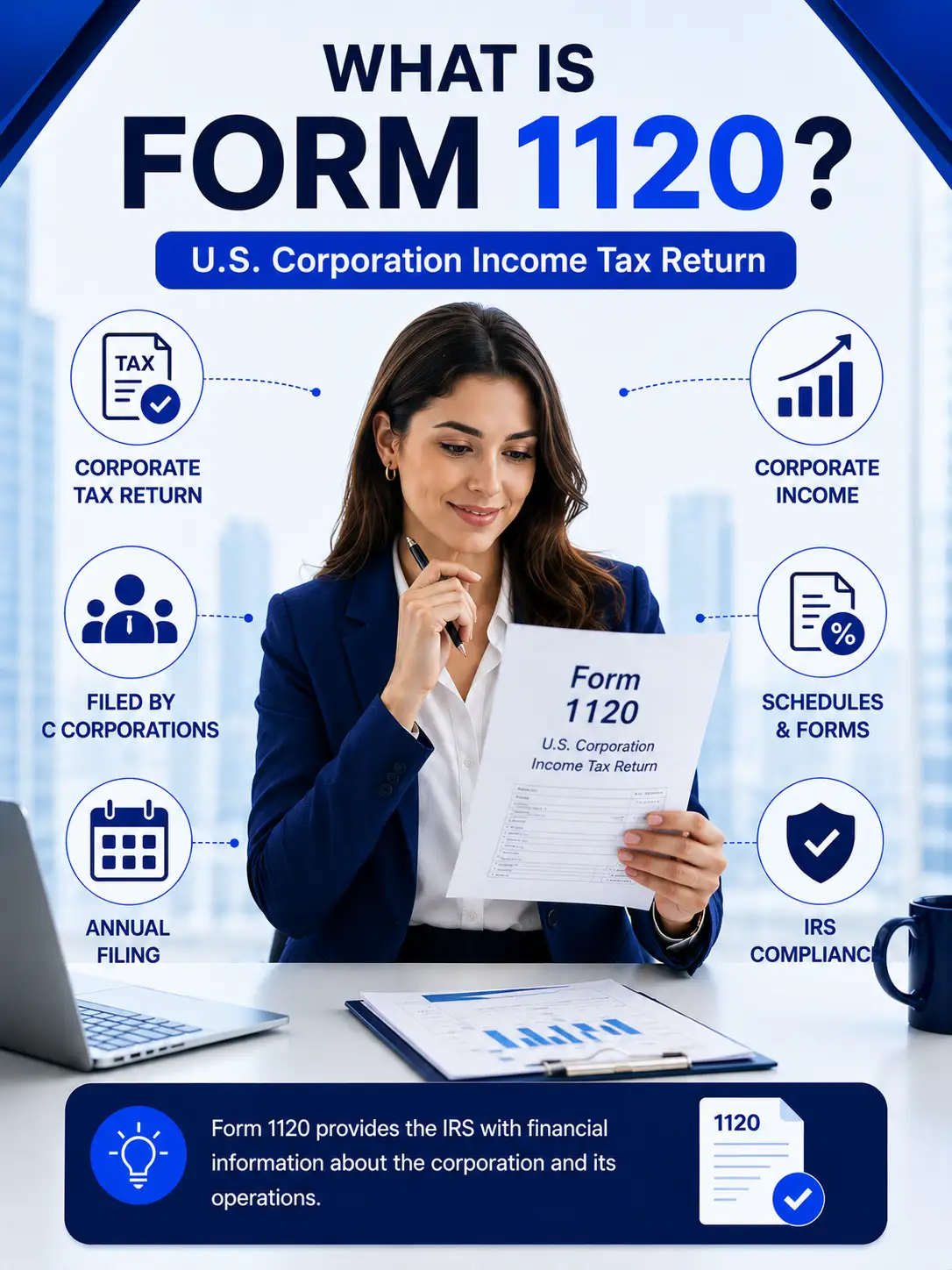
Form 1120 is the U.S. Corporation Income Tax Return. It is the federal tax form that every C-Corporation must file with the IRS to report its income, gains, losses, deductions, and credits, and to calculate its federal tax liability.
Unlike Form 1040, which is used by individuals, Form 1120 is filed by the corporation itself. Whether you’re running an active US Inc, a newly incorporated startup right after your C Corporation registration in USA, or a foreign-owned corporation with no US income, this Corporate tax return filing service is important because Form 1120 generally must be filed every year – even if the corporation had no revenue.
Depending on your corporation’s activities, you may also need to file additional forms and schedules, including Schedule C, Schedule J, Schedule K, Schedule M-1, Form 1125-A, and, for foreign-owned corporations, Form 5472 for related-party transactions. These returns are filed electronically through the IRS’s Modernized e-File (MeF) system.
File Form 1120 online through our service, and let our experts determine which forms and schedules your corporation needs.
Who Needs Our Form 1120 filing service?
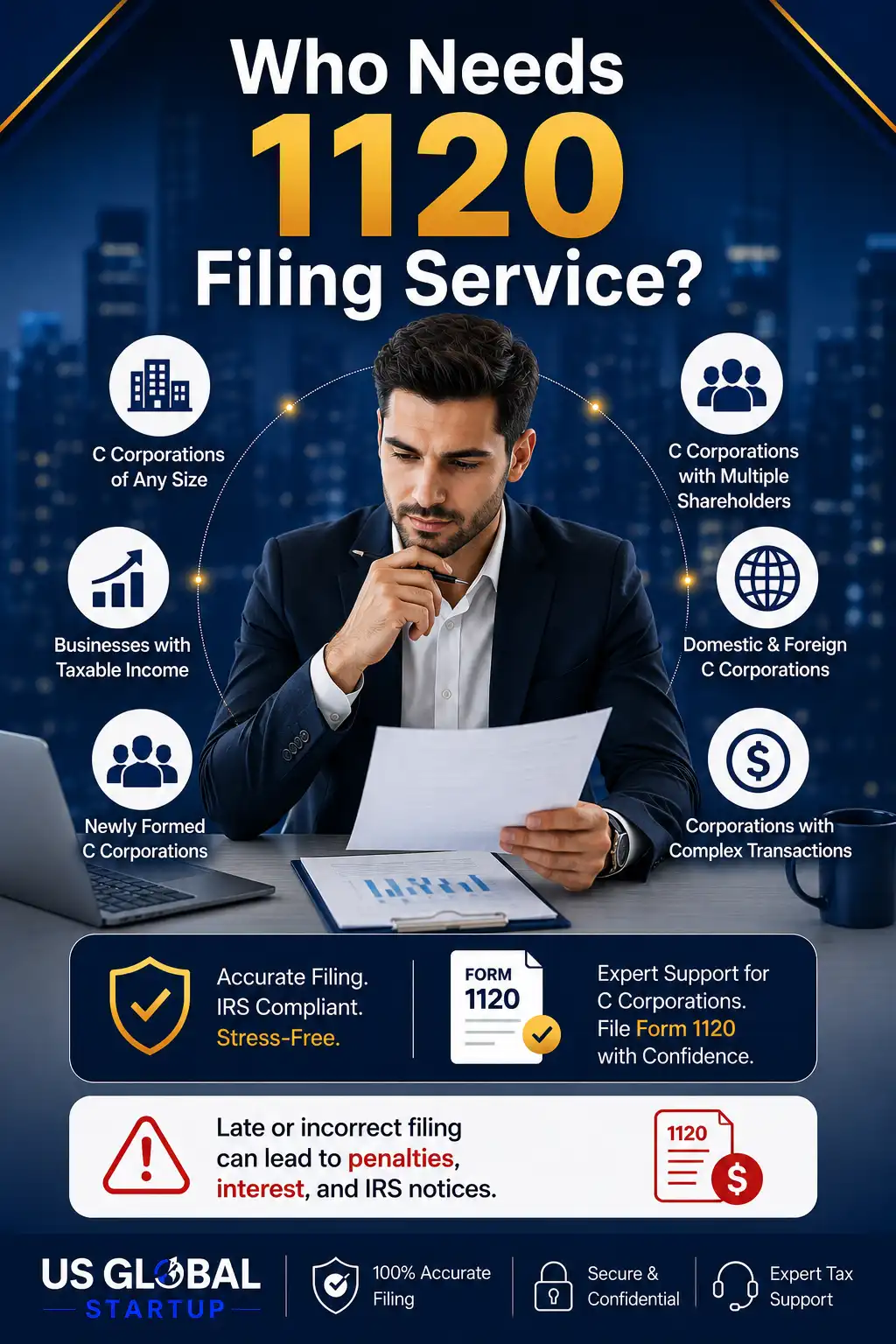
If you’re unsure whether your corporation needs to file, here are the most common situations where our Form 1120 filing service applies:
- Domestic C-Corporations – Every US C-Corp must file Form 1120, even if it had no income or business activity during the year.
- Newly incorporated companies – Any new Inc that hasn’t elected S-Corp status is automatically treated as a C-Corp and must file.
- Foreign-owned US corporations – Corporations owned 25% or more by a non-US person or entity generally must file Form 1120 and may also need Form 5472 filing.
- US subsidiaries of foreign companies – Must report their US income through Form 1120.
- Dormant or inactive corporations – Even with no revenue, a zero-income Form 1120 is usually required to keep the corporation compliant.
- Corporations being closed – Filing continues until the corporation is officially dissolved.
If your corporation falls into any of these categories, our IRS Form 1120 preparation service handles the entire filing process based on your company’s specific situation.
Form 1120 Filing Cost
Accurate C-Corp Filing
Return prepared under current IRS corporate tax rules and current-year forms
No Guesswork on Schedules
We determine exactly which schedules and forms your Inc needs - nothing missed, nothing unnecessary
Form 5472 Coordination Included
For foreign-owned corporations, Form 5472 is handled together with your Form 1120 as a single filing process.
Built For Startups, Inc Owners & Foreign-Owned Corps
For active, new, and dormant corporations - priced based on your filing needs.
Stay Compliant, Avoid Penalties
File your C-Corp's federal tax return accurately and on time to stay compliant and avoid IRS penalties.
50+
1120 Return Filed
100%
E-Filed With IRS
Tax Form 1120 Filing Charges
- Form 1120 preparation (all applicable schedules)
- Corporate filing status review
- Form 5472 coordination (if applicable)
- Deduction and credit review
- IRS e-filing & confirmation
- Extension filing, if needed (Form 7004)
Form 1120 vs Form 1120-S vs Form 1120-F: What's the Difference?
Ready to File Form 1120 online? We’ll first confirm the correct IRS form for your corporation to ensure an accurate filing.
| Comparison | Form 1120 | Form 1120-S | Form 1120-F |
|---|---|---|---|
| Filed by | C-Corporations | S-Corporations | Foreign corporations with US income |
| Taxed at entity level? | Flat 21% corporate tax - Corporation reports the income | Pass-through to shareholders | Yes, on US-effectively connected income |
| Who reports income | The corporation itself | Shareholders via Schedule K-1 | The foreign corporation |
If you’re not sure which return your corporation should file, our team will identify the correct form before preparing your return. Filing the wrong form can lead to IRS notices, delays, and processing issues.
What Schedules Are Required With Form 1120 Filing?
Form 1120 usually requires additional schedules based on your corporation’s activities, ownership, and deductions. As part of our 1120 tax preparation for C corporation service, we determine exactly which schedules your corporation needs before filing.
- Schedule C : dividends, inclusions, and special deductions
- Schedule J : tax computation and payments, including credits
- Schedule K : general information about the corporation, accounting method, and ownership
- Schedule L : balance sheet as reported on the corporation's books
- Schedule M-1 : reconciliation of book income to taxable income
- Schedule M-3 : required instead of M-1 for corporations with $10 million or more in total assets
- Form 1125-A : cost of goods sold, for corporations reporting inventory
- Form 1125-E : compensation of officers, required if total receipts are $500,000 or more
- Form 5472 : related-party transaction disclosure, required for foreign-owned corporations
What Documents Are Required to File Form 1120?
- EIN (Employer Identification Number) confirmation letter and incorporation documents
- Prior year's Form 1120, including any net operating loss (NOL) carryforward
- Income statement, balance sheet, and cash flow statement (from your bookkeeping or accounting records)
- Bank and credit card statements, general ledger, trial balance
- Payroll records, W-2s, W-3, and Form 941 (if you have employees)
- Form 1099s received and sales records
- Fixed asset and depreciation schedules
- Foreign ownership documents - Form 5472, W-8BEN (if applicable)
- Business expense records: rent, utilities, professional fees, advertising
- Prior state corporate tax return or franchise tax filings, if applicable
How Our Form 1120 Filing Service Works - Step-by-Step Guide
Here’s how our Form 1120 filing service works, from document collection to IRS e-filing.
Step 1: Provide Your Corporation Details
Tell us about your corporation, ownership structure, and tax year-end so we can confirm your filing requirements.
Step 2: Send Your Financial Records
Share your income statement, balance sheet, expense records, and other required documents. We’ll review everything and determine which schedules are needed.
Step 3: We Prepare Your Form 1120
We prepare your Form 1120 along with all required schedules and forms, including Form 5472 where applicable.
Step 4: Review and Approval
We’ll send you the completed return for review. Nothing is filed until you approve it.
Step 5: IRS E-Filing & Confirmation
Once approved, we File Form 1120 online with the IRS and send you the e-filing acknowledgment receipt.
How Long Does It Take to Prepare a Form 1120 Return?
The time required depends on your corporation’s records and filing complexity. Most 1120 tax filing service requests are completed within 7–12 business days after we receive all required documents. Returns involving foreign ownership, multiple states, or additional tax forms may take longer.
Form 1120 Filing Deadline
- April 15 – For calendar-year C-Corporations (or the 15th day of the 4th month after the end of a fiscal year)
- Estimated tax payments – Due April 15, June 15, September 15, and December 15 for corporations expecting to owe tax
Missing the deadline doesn’t just cost penalties – it can also affect good standing and make it harder to raise capital or sign contracts as a corporation.
Form 1120 Extensions Period
Yes – you can request more time to file Form 1120, but it isn’t automatic and it doesn’t extend your payment deadline.
- File Form 7004 on or before your original due date to get an automatic 6-month extension
- Estimate and pay your tax owed by the original deadline, even while the extension is pending – the extension applies to paperwork, not to payment
- Interest still accrues on any unpaid balance from the original due date, even with an approved extension
- No reason or explanation required – Form 7004 is generally granted automatically as long as it’s filed correctly and on time
Filing Form 7004 late, or filing Form 1120 itself late without an extension in place, is what triggers the failure-to-file penalty – so the extension only protects you if it’s submitted before the original deadline passes.
Can I File Form 1120 Late? What Are the Penalties?
- Failure-to-file penalty – 5% of the unpaid tax per month, up to a maximum of 25%
- Interest charges – Apply to any unpaid tax in addition to penalties
- Form 5472 penalty – $25,000 per missed form, per year, for foreign-owned corporations that fail to report related-party transactions
- Loss of good standing – Can affect banking, financing, and other business activities
Even if your corporation had no income or business activity, it may still need to file a zero-income Form 1120 to remain compliant with IRS filing requirements.
What Deductions Can I Claim on Form 1120?
A large part of accurate Form 1120 preparation is making sure your Inc claims every deduction it’s legally entitled to – not just the obvious ones. As part of our small business corporate tax filing service, we review your books specifically to identify:
- Officer compensation and salaries : deductible on Form 1125-E when total receipts exceed $500,000
- Cost of goods sold (COGS) : reported on Form 1125-A for corporations carrying inventory
- Depreciation and amortization : on equipment, software, and fixed assets, using current IRS depreciation schedules
- Business rent, utilities, and office expenses
- Employee benefits and retirement plan contributions
- Professional fees : legal, accounting, and consulting costs
- Advertising and marketing expenses
- Bad debt deductions : where applicable
- Net operating loss (NOL) carryforward : from prior tax years
- R&D tax credit : for corporations with qualifying research and development expenses
- Charitable contributions : subject to the 10% of taxable income limit for corporations
Deductions missed on Form 1120 don’t roll over automatically – once a return is filed, correcting a missed deduction means filing an amended return. Our 1120 tax preparation for C corporation service reviews your full expense picture before filing to help maximize eligible deductions.
Do I Need an EIN to File Form 1120?
Yes – an EIN (Employer Identification Number) is mandatory to file Form 1120. The IRS uses it to identify your corporation on the return, and without one, your Form 1120 cannot be processed or e-filed.
Should You Hire a CPA to File Form 1120?
You can prepare Form 1120 yourself if your corporation has a simple tax situation. However, filing becomes more complex if your business has foreign ownership, multi-state operations, depreciation, R&D credits, or prior-year losses.
If you’d rather leave it to a professional, our Corporate tax return filing service is handled by a licensed CPA who prepares your return, completes all required schedules, and files it directly with the IRS.
If you also need to File Business Taxes Online for an LLC, partnership (Form 1065), or your personal Form 1040-NR as a foreign owner, our team can handle those filings together for a complete compliance solution.
Frequently Asked Questions
Common question about Form 1120 filing
What is the corporate tax rate on Form 1120?
Form 1120 income is taxed at a flat 21% federal corporate income tax rate under the Tax Cuts and Jobs Act, regardless of the corporation's income level. State corporate tax or franchise tax is calculated and filed separately from your federal return.
Can a dormant or inactive corporation skip Form 1120?
No. Even with zero income and zero activity, your C-Corporation must still file a "zero income" Form 1120 to remain compliant and in good standing.
Does My Corporation Have to E-File Form 1120?
In many cases, yes. For returns filed on or after January 1, 2024, corporations that file 10 or more returns of any type during the calendar year (including Forms W-2 and 1099) are generally required to e-file Form 1120 instead of submitting a paper return. Our service e-files directly with the IRS as standard
What is Form 5472, and when is it required with Form 1120?
How Much Does It Actually Cost to File Form 1120?
Our Form 1120 filing service starts at $250 for a straightforward C-Corporation tax return. The final fee depends on your corporation's transaction volume and turnover, as businesses with more activity require additional review and preparation. We'll provide a fixed quote after reviewing your financials - no hidden or surprise charges.
Why Form 1120 Filing Is More Expensive Than Personal Taxes?
Form 1120 requires significantly more work than a personal tax return. It involves reviewing financial statements, preparing multiple schedules (such as Schedule C, J, K, L, and M-1/M-3), and verifying deductions and officer compensation against the corporation's records.
For foreign-owned corporations, Form 5472 may also be required, and many businesses have separate state tax filing obligations. While a personal return mainly reports individual income, a corporate return requires a complete review of the company's financial records, making it more complex and time-consuming to prepare accurately.
Can My Corporation File Form 1120 Electronically?
Yes - in fact, most corporations are required to. Corporations that file 10 or more returns of any type in a calendar year (including W-2s and 1099s) must e-file Form 1120 through the IRS's Modernized e-File (MeF) system rather than mailing a paper return.
Form 1120 vs S-Corp Election: Which Saves More on Taxes?
It depends on your business. Form 1120 applies to C-Corporations, which pay a flat 21% federal corporate tax, while S-Corporations pass income directly to shareholders. S-Corp status isn't available to foreign-owned corporations. The best option depends on your ownership, profits, and long-term goals, so it's worth reviewing with a professionals before making an election.
How Do You Pay Form 1120 Corporate Taxes?
Corporations can pay their Form 1120 tax liability through EFTPS (Electronic Federal Tax Payment System), IRS Direct Pay, an approved debit or credit card processor, or by check or money order with Form 1120-V. If your corporation expects to owe $500 or more in tax, it generally must make quarterly estimated tax payments to help avoid underpayment penalties.
Are There Alternatives to Form 1120 for Small C-Corporations?
No. Every C-Corporation must file Form 1120, regardless of its size. However, some small corporations may qualify to skip Schedule L, M-1, and M-2, making the return simpler. Another option is electing S-Corp status, but that's a different tax structure - not an alternative to Form 1120 - and it isn't available to foreign-owned corporations.