

LLC vs C Corporation For Non Residents: Taxes, Benefits & Tax Advantages for Foreigners
If you’re a foreign founder planning to register company in USA, one question comes up almost immediately:
LLC vs C-Corp for non-residents – which one should I choose?
This is not just a technical or legal choice. The business structure you select in the US directly impacts how much tax you pay, what compliances you must file every year, how investors view your company, and how smoothly you can operate from outside the US.
In practice, I’ve seen many non-resident founders — especially from India — rush into company registration after watching a YouTube video or following generic advice like “LLC is best for foreigners” or “Delaware C-Corp is mandatory.” Often, this happens without understanding what LLC registration in USA actually involves for a non-resident, or how it compares to other structures. The result?
A structure that looks fine on paper but creates problems later – higher taxes, unexpected filings, or the need to restructure the company when it’s already generating revenue.
The reality is simple:
There is no one-size-fits-all answer. An LLC and a C-Corporation for international founders serve very different purposes, and the “right” choice depends on how you plan to make money, where your clients are, and what your long-term goals look like. If your goals include raising venture capital or issuing equity to investors, understanding C Corp registration in USA becomes especially important, since it directly shapes how you structure ownership from day one.
In this guide, I’ll break down LLC vs C-Corp for non-residents in clear, practical terms — no legal jargon, no theory. You’ll see:
How each structure works for foreign owners
What Indian and other non-US founders should specifically watch out for
Real-world scenarios where one structure makes sense and the other doesn’t
By the end, you’ll be able to choose the right US company structure with confidence, without unnecessary tax exposure or compliance stress — and without needing to undo mistakes later. Getting your structure right from the start also makes ongoing compliance far simpler, especially when it’s time to rely on a US Federal Tax Filing Service to stay on top of your annual obligations.
Understanding Company Structures in the USA for Foreigners
Before comparing anything, let’s get one thing clear.
In the United States, your company structure is not just a registration formality. It defines how your business operates on a day-to-day basis and how the US government, banks, investors, and even clients perceive your company.
Your chosen structure directly impacts:
- How and where your company is taxed
- What IRS forms you must file every year
- Whether investors take your business seriously
- How easy it is to manage everything remotely from outside the US
Your structure also determines the compliance steps that follow — for instance, every US company needs EIN Registration to open a business bank account and file taxes, and depending on your role in the company, you may also need ITIN Registration if you don’t qualify for an SSN but still have US tax filing obligations.
For non-residents, including Indian founders, two structures actually matter:
- Limited Liability Company (LLC)
- C Corporation (C-Corp)
S Corporations are not available to foreign owners, so we’ll keep the focus on the options that genuinely apply to you.
Before you even get to choosing a structure, though, it helps to know what paperwork you’ll be dealing with — our Document Required to Register Company in USA from India walks through exactly what you’ll need to have ready.
What Is an LLC and Why Non-Residents Prefer It
An LLC is the most popular choice among non-resident founders – especially those running online businesses, agencies, SaaS tools, eCommerce stores, or consulting services. Many Indian founders, for example, choose to open LLC in USA for Amazon FBA because it offers a simple, low-cost way to sell on the US marketplace without dealing with unnecessary compliance overhead.
From a foreign founder’s perspective, LLCs feel familiar because they are flexible, cost-efficient, and relatively easy to manage remotely.
How an LLC Works for Non-Residents
By default, an LLC is treated as a pass-through entity for US tax purposes. This means:
The company itself does not pay federal income tax
Profits or losses “pass through” to the owner
Tax depends on whether the income is considered US-sourced
For non-resident owners, this often results in simpler taxation and fewer corporate formalities, especially when business operations are managed from outside United States. This simplicity is one of the main reasons LLCs are often seen as the best business structure in the USA for non-residents starting small or testing the US market.
It’s about how you plan to use your US company, how you’ll earn money, and whether you plan to raise funding in the future. Let’s break this down in a way Indian founders actually understand.
Key Benefits of an LLC for Foreigners
When comparing LLC vs C-Corp for foreigners, LLCs clearly stand out for flexibility and ease.
- Easier compliance with fewer annual filings
- Lower setup and maintenance costs
- No requirement for a board of directors
- Flexible management (owner-managed or manager-managed)
- Ideal for solo founders, freelancers, and small teams
This is why many foreign founders choose an LLC when launching service-based or remote-first businesses. Once you’ve decided on an LLC, the next question is usually which state to register in – and comparing Wyoming vs Delaware LLC for non residents is a good starting point, since these two states are the most popular among foreign founders for different reasons.
Limitations of an LLC
That said, an LLC is not perfect for every situation.
Venture capital firms rarely invest in LLCs
Ownership transfers can be more complex
Certain tax scenarios become complicated as revenue grows
If your long-term plan includes raising VC funding or issuing equity, an LLC may not be the best structure to stick with forever.
What Is a C-Corp and When It Makes Sense for Non-Residents
A C-Corporation is a more formal structure and is widely used by high-growth startups, especially those planning to raise US funding.
How a C-Corp Works
A C-Corp is treated as a separate legal and tax-paying entity.
The company pays corporate income tax
Shareholders are taxed again when profits are distributed
This is commonly known as double taxation, and it’s one of the reasons early-stage founders hesitate to choose a C-Corp too soon.
Benefits of a C-Corp for Non-Residents
Despite higher compliance, C-Corps offer advantages that LLCs simply cannot.
Preferred structure for US investors and VCs
Easy issuance of shares and stock options
Designed for long-term scalability
Clear separation between company and owners
When founders evaluate LLC or C-Corp for non-residents, those planning to raise capital almost always lean toward a C-Corp – usually a Delaware C-Corp.
Drawbacks of a C-Corp
Higher tax and compliance costs
More paperwork and reporting requirements
Annual meetings and formal records
Higher accounting and legal fees
A C-Corp only makes sense when growth and funding justify the complexity.
Once your company is set up, the next practical step most founders take is to open bank account in USA for non residents, so you can start receiving payments, paying vendors, and keeping your business finances separate from day one.
LLC vs C-Corp Taxes: What Non-Residents Must Know
Taxes are often the deciding factor in the LLC vs C-Corp tax debate.
Tax for LLCs
For foreign-owned single-member LLCs:
No corporate income tax by default
Mandatory informational filings with the IRS
Taxes depend on whether income is effectively connected to the US
When structured correctly, LLCs can be very tax-efficient for smaller or service-based businesses.
Tax for C-Corps
C-Corps pay:
Federal corporate tax (currently 21%)
State corporate tax, depending on where the company is registered
If profits are distributed, shareholders may also face withholding taxes. This makes C-Corps more expensive – but predictable and investor-friendly.
LLC vs C-Corp Benefits: Side-by-Side Comparison
| Factor | LLC | C Corp |
|---|---|---|
| Ownership | Flexible | Share based |
| Taxation | Pass through | Corporate tax |
| Compliance | Lower | Higher |
| Fund raising | Limited | Investor friendly |
When founders ask which is better: LLC or C-Corp for non-residents, the answer always depends on business goals.
Fundraising & Investment Perspective
For many founders, fundraising becomes the real turning point in the LLC vs C-Corp for non-residents decision. You might start a business thinking you’ll never raise capital – but plans change. And when they do, your company structure suddenly matters a lot more than your idea alone.
Founders planning to raise capital or issue equity usually start with a Delaware C-Corp. From an investor’s perspective, structure equals risk, clarity, and exit potential.
Why Investors Prefer C-Corps
Investors expect a company structure that is built for equity, governance, and exits. This is where C-Corps clearly stand out.
A C-Corp offers:
Clean cap tables that clearly show ownership
Easy share transfers, which matter during funding rounds
A familiar legal framework that US investors already understand
Standard exit mechanisms like acquisitions or IPOs
In real-world terms, most venture capital firms, angel networks, and institutional investors won’t even review a pitch unless the company is structured as a C-Corp — usually a Delaware C-Corp.
It’s not personal. It’s about efficiency and risk management on the investor’s side.
Can LLCs Raise Funds?
Yes, LLCs can raise funds – but it’s rarely smooth.
Investors generally avoid LLCs because:
Ownership is membership-based, not share-based
Profit distributions can become complicated
Tax treatment is unclear or unattractive for foreign investors
In practice, what often happens is this:
An international founder starts with an LLC, gains traction, and then needs funding. The investor’s first condition? Convert to a C-Corp.
That conversion:
Adds legal and accounting costs
Delays funding timelines
Creates avoidable complexity
This is why founders who know they will raise capital often choose a C-Corp from day one
LLC vs C Corporation for Small Business Owners
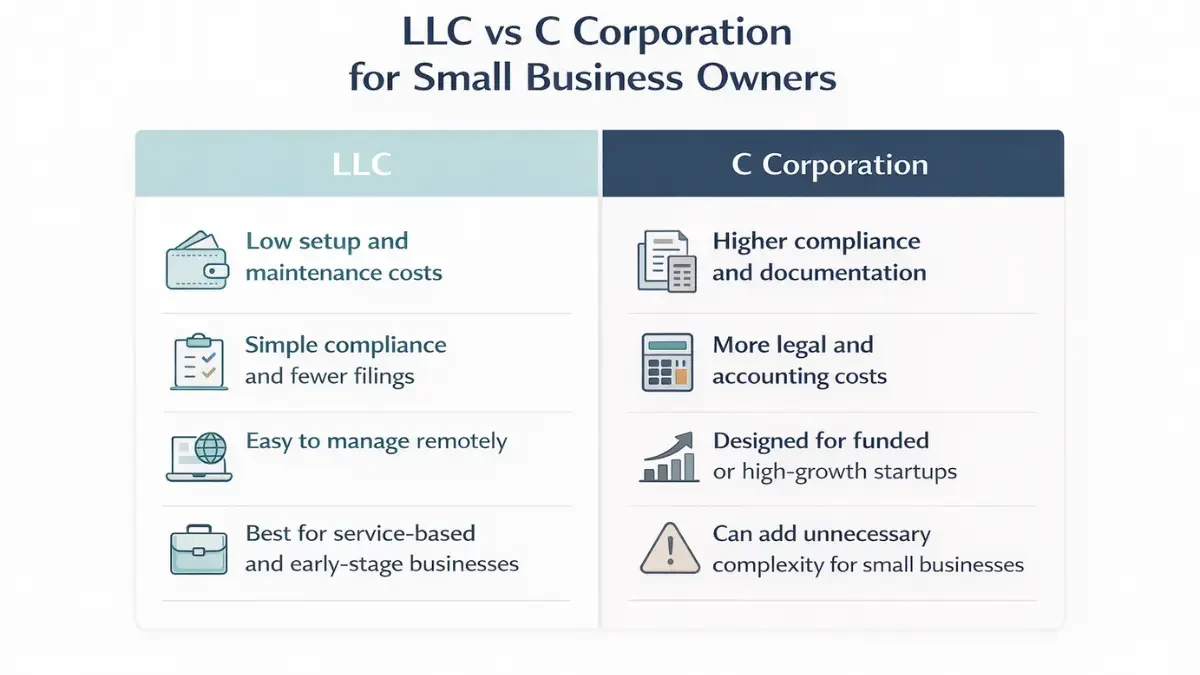
Not every business needs funding, stock options, or complex governance. For freelancers, consultants, agencies, and service providers, LLCs are usually the smarter and more practical choice.
LLCs:
Keep setup and annual costs predictable
Reduce compliance pressure
Work extremely well for remote-first operations
At this stage, a C-Corp often adds paperwork without adding value. For most small business owners, simplicity beats sophistication.
LLC vs C Corporation for Foreign Ownership
Both LLCs and C-Corps for non rsidents allow 100% foreign ownership. You do not need a US citizen or resident partner.
The difference lies in management and future flexibility:
LLCs are simpler to run day-to-day, even from outside the US.
C-Corps are better aligned with fundraising, scaling, and exits
So the decision isn’t about permission – it’s about long-term fit. Regardless of which structure you pick, the state you register in also plays a big role in your costs and compliance — our Best State to Register a Company in USA for Foreigners guide breaks down which states make the most sense depending on your goals.
Ownership Transfer & Exit Strategy
Your choice today affects how easily you can exit tomorrow.
Selling an LLC
Selling an LLC is possible, but often complicated. The process depends heavily on:
Operating agreements
Member approvals
Buyer concerns around tax treatment
For non-residents, this can introduce additional legal steps and delays during an exit. In some cases, founders choose to convert their LLC into a C-Corp before selling, and understanding Domestication of Corporation & LLC can help you evaluate whether that route makes the exit process smoother.
Selling a C-Corp
C-Corps are far easier to sell.
Because ownership is divided into shares, buyers can:
Purchase partial or full ownership
Complete acquisitions without restructuring
Execute exits efficiently
This is why most US acquisitions happen at the corporation level, not through LLCs.
Common Mistakes Non-Residents Make
Many founders struggle not because of their idea – but because of early structural choices.
Choosing a C-Corp too early
Some founders pick a C-Corp simply because it “sounds professional.” This often leads to:
Higher costs
Unnecessary compliance
Slower early-stage execution
Ignoring long-term tax implications
Taxes should never be an afterthought. Poor planning around withholding, reporting, and distributions can become expensive later.
Not planning for future funding or exits
The smartest founders ask:
Where will this business be in 2–5 years?
Will I raise capital later?
Will I sell or exit?
Your structure should support those answers, not block them.
Quick Decision Guide – LLC or C-Corp For Non Residents?
If you want a simple rule of thumb:
Choose an LLC if you are:
A freelancer or consultant
Running an agency or service business
Bootstrapping without external investors
Choose a C-Corp if you are:
Building a startup or SaaS product
Planning to raise US funding
Aiming for high-growth exits
This framework helps founders decide without overthinking.
Final Verdict: LLC vs C-Corp for Non-Residents
There is no universal answer.
If simplicity, cost control, and flexibility matter most, an LLC is often the right starting point.
If fundraising, scaling, and investor readiness are priorities, a C-Corp is the better fit.
Making the right choice upfront saves time, money, and painful restructuring later – especially for non-resident founders.
Ready to Choose the Right Structure?
If you want expert guidance on selecting the right structure, registering your company, opening a US bank account, and staying compliant – we’re here to help.
Common FAQs on LLC or C Corp For Non Residents
LLC vs C Corp: Which Business Structure Saves You More Money in Taxes?
LLCs generally save more on taxes for solo founders and small remote businesses, since profits pass through and, in many cases, aren't taxed by the US at all if there's no US-based activity. C-Corps pay a flat 21% corporate tax plus a second tax on dividends ("double taxation"), making them costlier - but they're often necessary if you're raising venture capital or scaling with investors.
Do I Really Need a Corporation or Is an LLC Enough for My Small Business?
For most small businesses, an LLC is enough. It's simpler to set up, cheaper to maintain, and gives you the same liability protection as a corporation — without the extra formalities like a board of directors or complex share structures. A corporation only becomes necessary if you're planning to raise venture capital, issue stock options, or bring on multiple investors down the line.
Is an LLC or Corporation Better for a Two-Person Business Partnership?
For most two-person partnerships, an LLC is better. You can use a simple operating agreement to define ownership splits, profit sharing, and decision-making between both partners, with far fewer formalities than a corporation. A corporation makes more sense only if you both plan to bring in outside investors or eventually issue shares to future partners or employees.
How Hard Is It to Switch From an LLC to a C Corporation Later?
Switching from an LLC to a C-Corp is doable, but it involves real legal and administrative work — it's not a quick paperwork update. The process, called "conversion" or "domestication," typically means forming a new C-Corp, transferring the LLC's assets and contracts to it, reissuing ownership as shares, and updating your EIN, bank accounts, and tax filings. Many founders choose to do this specifically when raising venture capital, since investors usually require a C-Corp structure. It's manageable, but it's easier to start with the right structure than to convert later.
How Do Banks and Creditors Treat LLCs vs Corporations?
Banks and creditors offer similar liability protection for both, but corporations are often seen as more credit-worthy due to their formal structure. LLCs can face slightly more scrutiny, especially if owner-managed with minimal documentation. What matters most to banks either way is having a US bank account, EIN, and clean financial records.
Do Customers Trust LLCs Less Than Corporations?
Not really - most customers don't distinguish between an LLC and a corporation, and it rarely affects everyday buying decisions. Trust usually comes from your branding, website, reviews, and customer service, not your legal structure. The exception is in industries like finance, enterprise B2B, or when dealing with larger corporate clients, where a "Corporation" or "Inc." label can sometimes feel more established than "LLC."
Do Customers Trust LLCs Less Than Corporations?
Not really - most customers don't distinguish between an LLC and a corporation, and it rarely affects everyday buying decisions. Trust usually comes from your branding, website, reviews, and customer service, not your legal structure. The exception is in industries like finance, enterprise B2B, or when dealing with larger corporate clients, where a "Corporation" or "Inc." label can sometimes feel more established than "LLC."