

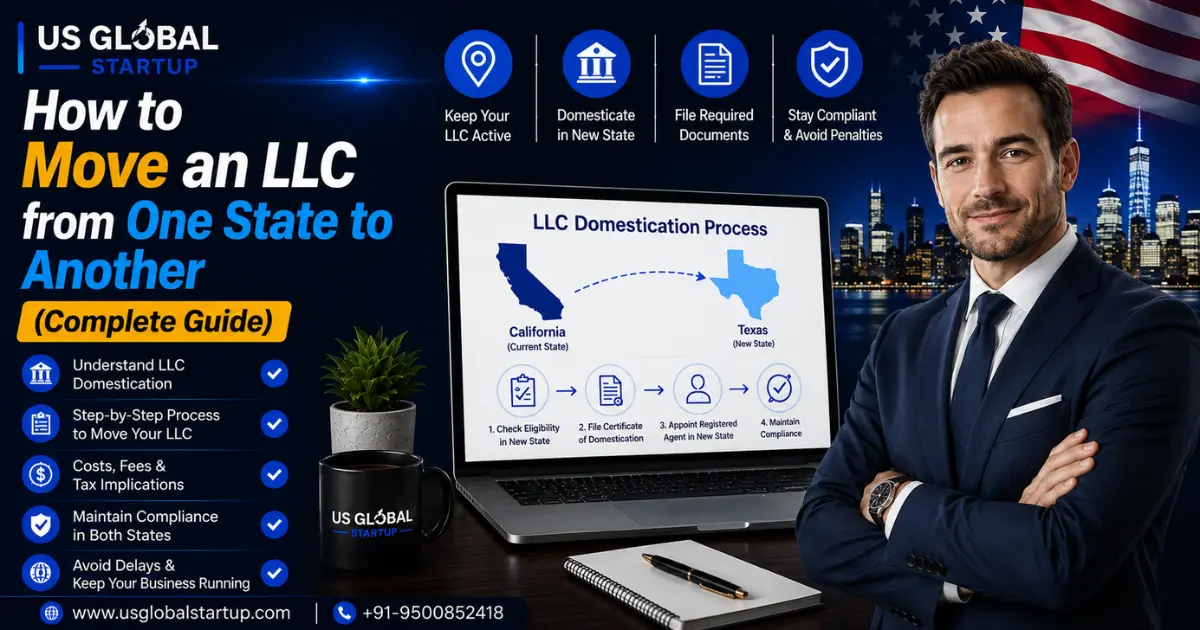
How to Move an LLC from One State to Another State Legally - Complete Step-by-Step Guide
If you’ve relocated, You may find a state with lower annual fees, better tax benefits or stronger privacy protections, you may be wondering How to Move an LLC from One State to Another without starting over. Many business owners want to move LLC from one state to another without affecting their existing contracts, EIN, bank account, or business history.
The good news is that, in many cases, you don’t have to start from scratch. Through LLC domestication, you can legally transfer LLC to another state while keeping the same EIN, contracts, and business records. This means you usually don’t need to dissolve LLC and form new LLC, saving both time and paperwork.
In this guide, you’ll learn how to transfer an LLC to another state, when it makes sense to domesticate LLC to another state, the documents you’ll need, and the cost of LLC domestication. If you’d rather have an expert handle the entire process, our Domestication of LLC service manages the filing from start to finish.
What Is LLC Domestication?
LLC domestication is a legal process that allows an existing Limited Liability Company (LLC) to change its state of formation while keeping the same business entity, Name, EIN and banking history.
Instead of dissolving your company and forming a brand-new LLC, domestication lets your business continue operating under the laws of a different state.
For example:
- A Delaware LLC may move to Wyoming.
- A Nevada LLC may relocate to Texas.
- A Florida LLC may transfer to another eligible state.
If your goal is to move LLC from one state to another while keeping your business legally intact, LLC domestication is usually the best option, If both state allows it.
LLC Domestication vs Foreign Qualification vs Dissolving an LLC
Before you decide to relocate an LLC to another state, it’s important to understand the three main options. The right choice depends on your business and whether your current and new states allow to domesticate LLC.
1. LLC Domestication (Best for Permanent Relocation)
With LLC domestication, you move LLC from one state to another as the same legal business. Your EIN, contracts, business history, and bank accounts usually stay the same. This option is available only if both your current state and your new state allow domestication.
2. Foreign Qualification
Instead of moving your LLC, you keep it registered in the original state and register it as a foreign LLC in the new state. This allows you to do business in both states, but you’ll have ongoing filing requirements and fees in both.
3. Dissolve LLC and Form New LLC
If your state doesn’t allow LLC domestication, you’ll need to dissolve LLC and form new LLC in the new state. This means closing your existing company, creating a new one, and transferring your contracts, assets, licenses, and bank accounts. In many cases, you’ll also need a new EIN.
For most business owners who want to relocate LLC to another state permanently, domestication of LLC is usually the simplest option. However, it’s only available if both states allow the process. Before you domesticate LLC to another state, make sure your current state allows an outbound domestication and your new state accepts an inbound domestication. If both provide, then you can move LLC to another state without creating a new business or dealing with ongoing foreign qualification requirements.
How to Domesticate LLC in USA: Which States Allow It
Not every state allows LLC domestication, and this is the first thing you should check before planning your move. If you’re trying to domesticate LLC in USA, states like Delaware, Wyoming, Florida, Texas, and Arizona are commonly known for allowing LLCs to move in and move out through domestication.
Some states only allow inbound domestication (accepting an LLC from another state), while others only allow outbound domestication (allowing an LLC formed there to move to another state). That’s why you need to check both your current state’s rules and your new state’s rules before assuming domestication is possible.
If your states don’t allow domestication, then dissolve LLC and form new LLC or foreign qualification will usually be the practical alternative instead.
How to Move an LLC From One State to Another State (Step-by-Step)
If both your current state and the destination state allow domestication, the process is often much simpler than dissolving your company and creating a new one.
Step 1: Confirm That Both States Allow LLC Domestication
Not every state domesticate LLC in USA. So before filing any documents, confirm that:
- Your current state allows businesses to transfer out.
- The new state allows businesses to transfer in.
If either state doesn’t support domestication, you’ll likely need to consider another option, such as foreign qualification or choosing to dissolve LLC and form new LLC.
Step 2: Choose Your New State Carefully
Before deciding where to move your LLC, compare:
- Annual filing fees
- State taxes
- Privacy protections
- Reporting requirements
- Registered agent requirements
- Long-term compliance costs
Many business owners compare different states before making a decision. Our guide on Wyoming Vs Delaware LLC For Non Residents explains why these two states remain popular choices.
Step 3: Get a Certificate of Good Standing
Before your LLC can be transferred, you’ll usually need a Certificate of Good Standing from your current state. This confirms your business is active and compliant.
If you don’t already have one, we can help you obtain your Certificate of Good Standing as part of the domestication process.
Step 4: Prepare Your Domestication Documents
Most states require several documents before approving the move, such as:
- Certificate of Domestication
- Articles of Domestication
- Articles of Organization
- Member approval resolution
- State filing forms
The exact documents depend on the state.
Step 5: Obtain Member Approval
Before you transfer LLC to another state, the LLC members (owners) usually need to approve the move.
The approval process depends on your Operating Agreement. In most cases, members sign a formal resolution approving the domestication and the new state of formation.
Step 6: File the Certificate of Domestication
(Called Articles of Domestication in some states.) You’ll file this with the new state’s Secretary of State, along with your new Articles of Organization.
Step 7: File dissolution or domestication paperwork in the old state
File the required domestication or dissolution documents to officially end your LLC’s status there after the new state approves the transfer.
Step 8: Update your registered agent
After the domestication process is complete, you’ll need a registered agent in your new state. If needed, we can change registered agent for LLC to complete this step.
Step 8: Receive Approval from the New State
After your application is submitted, the Secretary of State reviews your documents.
Once approved, your LLC officially becomes a company under the laws of the new state. Most states issue updated formation documents to confirm the domestication.
Step 9: Update your IRS records
After approval, update your business information wherever necessary, including:
- IRS records (your EIN usually stays the same)
- Business bank accounts
- Licenses and permits
- Vendor and customer records
- Contracts
- Insurance policies
- Marketplace accounts
- Payment processors
Keeping your records updated helps your business continue operating smoothly without compliance issues.
If either state doesn’t allow domestication, you’ll usually need to dissolve LLC and form new LLC instead. If that’s the right option for your business, our LLC registration in USA service can help you register your new company in your preferred state.
Registered Agent After Domestication: What You Need to Know
Once your domestication is complete, you’ll still need a registered agent with a physical address in your new state. Every state requires this to receive legal notices, tax documents, and other official correspondence on behalf of your LLC.
Your previous state’s registered agent won’t continue after the move, so you’ll need to appoint a new one in your destination state before or during the domestication process. This helps avoid any gap in compliance after your LLC is transferred.
If you need help with this step, we can help you to appoint registered agent that makes the transition simple and ensures your LLC remains compliant in its new state.
Does LLC Domestication Require a New EIN?
No. One of the biggest advantages of LLC domestication is that you can usually keep the same EIN. Since domestication keeps your LLC as the same legal entity, there’s no need to apply for a new EIN.
However, you should update your business address and state information with the IRS so your records remain accurate. If you also need to update your federal tax records after the move, our federal tax filing service can help ensure everything stays up to date.
How Much Does LLC Domestication Cost?
The cost of LLC domestication varies by state because you’ll usually pay filing fees in both your current state and your new state. Your original state may charge a fee for the outbound domestication or dissolution filing, while your new state charges for the inbound domestication and related formation documents.
In addition to state filing fees, you may also need to pay for a registered agent in your new state and, if required, professional assistance to prepare and file the domestication documents correctly. A small filing mistake can delay the process by weeks.
Our LLC Domestication service starts at $249 + applicable state filing fees. Since every state has different filing fees and requirements, the total cost depends on the states involved in your domestication.
Does Business Structure Affect LLC Domestication?
In most cases, LLCs and C-Corporations follow a similar domestication process, as long as both states allow it. The filing requirements are generally the same, although the specific documents may vary by state.
The main difference is why businesses choose to move. LLCs are often domesticated to reduce costs, simplify compliance, or relocate operations. C-Corporations, on the other hand, are commonly moved to Delaware to attract investors or support future fundraising.
If you’re also thinking about changing your business structure, our LLC vs C Corporation for Non-Residents guide explains the key differences. If a corporation is the better choice for your business, our C Corporation registration in USA service can help with the registration process.
Can I Move My LLC Without Paying State Fees?
No. Domestication of LLC always involves state filing fees because you’ll typically need to file documents with both your current state and your new state. The exact fees vary by state, but there isn’t a way to complete the process without paying the required government filing fees.
What Is the Domestication Document Called?
The main document used to move your LLC isn’t called the same thing in every state. Depending on the state, it may be referred to as:
| Name Used | States That Use It |
|---|---|
| Articles of Domestication | Wyoming, Iowa, Massachusetts, Minnesota, Nebraska, New Hampshire, New Jersey, North Dakota, South Dakota, Utah, Vermont, Virginia, Wisconsin, Indiana |
| Certificate of Conversion | Delaware, California, Georgia, Michigan, Ohio, Texas |
| Articles of Conversion | Florida, Nevada, North Carolina, Oregon, Washington |
| Statement of Domestication | Arizona, Connecticut, Idaho, Illinois, Mississippi, Pennsylvania, Alaska |
| Certificate of Domestication | Kansas |
Regardless of what it’s called in your state, it serves the same purpose – it legally transfers your LLC under the laws of your new state.
Typical filing fees by state (approximate, state fees change periodically):
| State | Formation/Domestication Filing Fee | Ongoing Annual Fee/Tax |
|---|---|---|
| Wyoming | ~$100 | $60 annual report |
| Delaware | ~$110–$300 | $300 annual franchise tax |
| Texas | ~$300–$600 | Franchise tax (revenue-based) |
| Florida | ~$125 | Annual report fee |
In addition to your new state’s filing fee, your original state may also charge a fee for the outbound domestication, withdrawal, or dissolution filing. These fees vary by state but are typically lower than the new state’s filing fee.
Besides government filing fees, you may also have costs for a registered agent, obtaining a Certificate of Good Standing, and professional filing assistance if you choose to use a service.
Our LLC Domestication service starts at $249 + applicable state filing fees. Since filing fees vary by state, the total cost depends on the states involved in your domestication.
Moving Your LLC: Which States Have the Lowest Fees?
If cost is the main reason for your move, a few states consistently offer the lowest filing fees and annual compliance costs.
| State | Filing Fee (Approx.) | Ongoing Annual Cost |
|---|---|---|
| Arizona | ~$50 | Low annual fee |
| New Mexico | ~$50 | No annual report required |
| Kentucky | ~$40 | Low annual fee |
| Wyoming | ~$100 | $60 annual report |
When Should You Dissolve LLC and Form New LLC?
While you can domesticate an LLC in the USA, it isn’t always possible or the right option. In some cases, dissolving your LLC and forming a new one is a better solution.
This is usually the right choice when:
- Your current state or new state doesn’t allow domestication. This is the most common reason, as not every state has domestication laws.
- Your business has changed significantly since it was formed, and you want to start fresh with a new ownership structure or updated operating agreement.
- You’re not concerned about keeping your current EIN or business history. For newer LLCs with little business activity, starting over can sometimes be simpler than going through domestication.
- Your LLC has been inactive for years and has accumulated IRS or state filing penalties. If you don’t need the same EIN or bank account, starting a new LLC in another state may be the simpler option.
Frequently Asked Questions
Common questions about How to Move an LLC from One State to Another State
Does My LLC's Bank Account Need to Change After Domestication?
Not usually. since your EIN and legal entity stay the same, you can generally continue using your existing business bank account. However, you should notify your bank and update your business address and state information to keep your records accurate.
Can Every State Domesticate an LLC?
No. Only about 60% of US states currently have domestication statutes, and some only allow it in one direction (inbound or outbound, not both). Always confirm both states' rules before planning around this option.
Is domestication the same as foreign qualification?
No. Foreign qualification keeps your LLC registered in its original state while adding a second registration in the new state, meaning ongoing obligations in both. Domestication fully transfers your LLC's state of organization to the new state, ending your obligations in the old one.
What Forms Do I Need to Move an LLC to Another State?
You'll typically need: a Certificate of Good Standing from your current state, a Certificate/Articles of Domestication filed in your new state, new Articles of Organization for the new state, and a dissolution or withdrawal filing in your old state once the move is approved. Exact form names vary by state, so it's worth confirming the specific paperwork with both Secretary of State offices before filing.
Will Moving My LLC Affect My Business Licenses or Permits?
Possibly. Domestication changes your LLC's state of organization, but some business licenses, permits, and local registrations may need to be updated or reissued in your new state. It's a good idea to review each license or permit individually instead of assuming it will transfer automatically.
How to Transfer LLC Ownership When Moving to Another State
Transferring LLC ownership and LLC domestication are two separate processes. Moving your LLC to another state doesn't automatically change who owns the business.
If you're adding, removing, or transferring ownership to another member, you'll usually need to update your Operating Agreement and, in some states, file additional documents to reflect the new ownership structure.
To avoid unnecessary complications, it's generally best to complete the ownership transfer either before or after the domestication process, rather than trying to do both at the same time.
What Happens to Taxes When You Move an LLC to Another State?
Your EIN and federal tax status stay the same, but your state tax obligations move to your new state. You may also need to file a final return in your old state and a first return in your new state during the transition year.
Final Thoughts
Moving an LLC to another state doesn’t mean starting over. If both states allow LLC domestication, you can transfer LLC to another state by following the required filing process and meeting both states’ compliance requirements. With the right preparation, the process is straightforward.
If you’re ready to move forward, US Global Startup handles the entire domestication process end to end – filings in both states, registered agent transition, and keeping your federal tax records consistent – so your business moves smoothly and remains compliant throughout the transition.